Tag: family

  • Unlucky and Still Good

    On Goodness and Leaving the Isle of the Blessed

    “One swallow does not make a spring, nor does one day. And in this way, one day or a short time does not make someone blessed and happy either.” — Aristotle, Nicomachean Ethics, I.7

    Aristotle’s argument that true flourishing requires more than good character—it requires “proper equipment.” Health. Wealth. Goodly children. And it seems that somewhere across the centuries, people began treating blessed as the goal rather than good, until the trappings of a certain kind of happiness came to stand in for virtue itself as the mark of a well-lived life.

    The trouble, of course, is that the equipment is not fully ours to control. What is needed to be good, however, is.

    And so, we return to the question we left hanging: why do you need to feel happy in order to be good?


    I have always been a light sleeper.

    I have been the proud owner of insomnia that predates the medical alarms by decades. In the years before my daughter, the silence of the night was a void I often filled with thought; now, the silence is a physical weight, a pressurized chamber. I lie awake at some unfathomable hour. Is it 11:00 PM or 3:00 AM? Does it matter? At this altitude, the distinction loses its utility. Time is no longer a sequence of events but a flat, humming plane.

    The house breathes through machines. There is the brown noise machine, churning out a static sea to negotiate an uneasy peace with the oxygen concentrator’s mechanical inhalation. Every few seconds, the ventilator interrupts with its rhythmic, insistent sigh, just dropping in a synthetic reminder of a life being sustained by a collective of wires and software. I hear these things, but they don’t break the silence. They create the kind of silence that makes your head ache, like the physical sensation of ears failing to pop as you climb into a thinning atmosphere. You are higher up than you were ever meant to be, and the old thick, easy oxygen of a “normal” life is gone.

    And in that ear-splitting silence, the unluckiest series of events takes our night to the places it so often goes. The smart speaker playing the brown noise decides to update. The break in the droning is just enough to make her hold her breath for a split second too long, which sets off the pulse-ox alarm. This wakes her with a start. Which triggers a seizure.

    Phone out and timing. Now all the alarms are screaming. The seizure won’t stop. Rescue meds administered. Phone now ready to call 911. The rescue meds finally take hold of her, and she settles. And in the middle of this chaos, the speaker emits a cheery dingUpdate complete. Brown noise resumes.

    We need to talk about the word unlucky.

    In the culture of caregiving, we are often coached to avoid this word. We are told to speak of “challenges,” “journeys,” or “special blessings.” We are encouraged to view our circumstances as a bespoke curriculum designed by the universe to refine our souls. But to look at my daughter’s room, or to look at her when her body is a site of systemic failure, and call it a “blessing” is a lie that insults her reality.

    We are, quite simply, profoundly unlucky. Luck is the name we give to the vast architecture of events that influence our lives but remain entirely outside our control. It is the genetic lottery and the random mutation, yes, but it is also the granular friction of the day-to-day: a suction tube getting impossibly caught on the corner of the couch when you are hurried, or receiving an entire box of diapers with the side tabs missing. When these events settle into the foundation of your life, they create a ruinous horizon. I look toward the future, and I do not see the milestones of graduation or the bright, messy independence of a growing child. I see the vacation photos that will never be taken. I see milestones that have hardened into millstones. These heavy, immovable facts that we must carry until one day we will bury them in the earth with her.

    By the time the sun actually rises, the adrenaline of the 3:00 AM seizure has curdled into a pungent, salt-rimmed exhaustion. We had recently had a long-term EEG day, and this morning’s requirement is a gentle tedious labor: washing the glue out of her hair. As luck would have it, she didn’t have any meaningful events while she was hooked up to the monitors so the task of having to excise glue from her tender scalp seems unnecessarily cruel.

    There is a specific, grey adhesive used to bind electrodes to a child’s scalp, designed to withstand the thrashing of a brain on fire. It is stubborn. It smells of solvent. As we work the adhesive remover into her hair, the sensory contrast is jarring. My fingers, calloused by the small, repetitive tasks of maintenance, feel the startling warmth of her scalp. Beneath the chemical smell of the glue that milk-warm, floral-earthy smell that is uniquely hers hits my nose.

    In these moments, she is often limp. The seizures and the medications have hollowed out her muscle tone, and she crumples into us. There is a terrifying beauty in that crumple. It is a manifestation of absolute trust, a weight that says, I cannot hold myself up, so you must. We are devoted to this weight; we take it up willingly, but it is not “joy.” It is not amusing or light.

    The world tells us that to be “good” parents, we must be “happy” parents. We are sold a version of virtue that is inseparable from a sunny disposition. Indeed, it seems that people would have you be happy and not good, rather than be good and unhappy. We are told that if we just “choose” enough gratitude, we can achieve a state of perfect contentment despite the ruins. To the outside observer, my wife and I standing over the sink might even look “inspiring.” People love that word; it makes them feel better about the fact that they aren’t the ones holding the washcloth. It is so important that we be happy that whole industries have popped up around it. Retreats promising to revitalize you, respite for date nights so you can find that spark of happiness again, mantras of ‘take the trip’ or ‘do the thing’ all with the design to get you happy again so you can get back to doing the hard work of parenting, or caregiving, or parent-caregiving as the case may be.

    For many, this is just what they need. The break to fill their own cup lets them pour their goodness back into their child’s care. Others deem it impossible to provide the care demanded of them unless they also have these happy moments provided for them as well. This is not an indictment of those who ‘take the trip’ or go on retreats. This is not a nihilistic rant against people being happy, and I’m not saying being this kind of happy isn’t at times helpful. But the mindset that you are owed happiness or even that you have earned it through your actions begs the question: Why hang your goodness on the hook of happiness? Why must you need these moments of pleasure in order to be good in the pain?

    Happiness, in the modern sense, is a fickle emotion, sometimes reduced to a chemical reaction to favorable circumstances. It’s hard to imagine a happy person who never smiles. But if you require that feeling in order to be a “good” person, what happens when the circumstances are objectively terrible? What happens when the “unluck” is permanent? Would you dare to be good even if you knew it would mean you’d never be happy, in the emotional sense, again?

    I have over the years come to believe that one of the most radical acts of care is to decouple the two. We can acknowledge that our lives are in ruins. We can admit to being fundamentally unhappy. And yet, in that thinning air, we can choose to be deeply, radically good. The “Good” person does good things—like scrubbing grey glue from a tired child’s head—not because it provides a “special” joy or for some reward, but for the sheer, deep, cognitive and spiritual devotion to the things that matter most, because they are the right things to do. We do not do it because we are “happy” to do it. We do it because she is here, and she is ours, and she is worth the exhaustion.


    This is a multi-part exploration of life on the far side of the thinning air of the (un)Blessed. This is a place where the old, easy oxygen has run out, but where a different, breathtaking view of the human spirit becomes visible.

    I am writing this not as a possessor of some immutable truth. The philosophy I’m exploring here is an experiment, more like a framework I’m “trying on” to see how it fits against the jagged edges of my daily life. I write with the conviction that survival often requires, but I am well aware that these ideas are contested and fragile. I may find I need a different set of tools after the next crisis.

    Next time we’ll step away from the sink and the solvent-smelling rituals to look at the “Why” we tell ourselves and why the search for a reason might be the very thing keeping us from finding our footing in the ruins. We’ll look at the view from the peaks, and why the “unlucky” are the only ones who ever get to see it.


    Until next time, stay safe, stay kind, and know that you are appreciated.

    Cheers,

    [kartoffelvater]


    Thank you for reading. For those of you coming back, or for finding your way here for the first time—I’m so glad you’re here. We wouldn’t be here without you. Every bit of support helps and we appreciate it more than words can say!
  • Can You Be Happy Without Being Good?

    Or in other words, can you be good without needing to also feel happy about it?

    The house is holding its breath again.

    Or maybe it’s just me. Her breathing has met her vent at its usual rhythm of 16 cycles per minute. A soft, synthetic sigh that cuts through the brown noise, but it’s the silence between the breaths that’s the loudest thing in the room. It’s that specific, pressurized hush that only exists in houses heavily modified for survival. It feels like the air has thinned, like I’m standing on a mountain peak where the oxygen is too scarce or too precious to chatter on about the old stories I used to tell myself. And yet chatter I will…

    I’ve been lying here for an hour.

    Aimlessly staring at the ceiling, trying to untangle a knot. When I was younger I used to be pretty good at undoing knots. Other kids would always bring me their yo-yos whenever the strings would get tangled up. Tonight though, this particular knot happens to be between my heart and my head.

    Who am I becoming in this?

    Not the father I planned to be. That man is gone, buried under layers of insurance denials, medication schedules, and the terrifying, beautiful weight of a child who cannot hold herself up. I don’t miss him, not really. He was a stranger anyway, a fantasy of sunlit driveways and training wheels. But I’m not sure who has taken his place.

    Someone told me the other day that I’m “so strong.” They said it with that bright, manic smile people wear when they’re terrified of the dark. They want me to be strong. They want me to be the oak tree that stands unbowed. At the very least they want me to think that they think I am strong like the oak. But I don’t feel like an oak. I feel like a spiderweb, trembling in the draft, knowing the wind is coming, knowing the threads will tear, and still, somehow, weaving.

    And that’s where the question starts to itch.

    If I am not happy does that mean I am doing this wrong? It certainly seems that way based on the reactions I get when I give an honest response to, “How are you?” If my life is objectively a tragedy, if the horizon is ruined and the air is thin, what’s the point? To choose joy and do what you can, cutoff whoever you need to, walk away from whatever you must, in order to be happy would seem to be the answer. But if all of that, if the word “happy” itself feels like a lie I’m telling myself to keep from screaming, can I still be a good person?

    We are taught that goodness and happiness are married. That if you are good, the universe will eventually reward you with peace, with joy, with a life that makes sense. Can you, then, be profoundly, deeply good in the midst of a life that offers you no joy? What if the only thing left to do is to be good because there is so little joy?

    I think about when we have to wash her hair in the sink. The grey adhesive from some hospital stay that won’t come out. The smell of solvent and the warmth of her scalp under my fingers. We scrub. We rinse. We do it again. We don’t do it because it makes us happy. It doesn’t. It’s tedious, exhausting, and often heartbreaking. We do it because she is here. Because she is ours. Because it is the right thing to do.

    Is that enough? Is that the only thing that matters?

    I feel a strange fear rising in my throat. Not fear of the future, or the next seizure, or the next bill. Fear of the possibility that I am wrong. That maybe I am just deluding myself, trying to find a philosophy to justify the pain. That maybe there is no “higher excellence” in this, just a slow, grinding erosion.

    But then I look at her. She’s asleep, her chest rising and falling with the help of the machine. She looks so small. So fragile. Our lovely round baby girl has gotten so skinny. And yet, there is a dignity in her sleep that is almost a question. One that I don’t understand how to answer. I don’t have the words for it. I just know that the old language of “blessing” and “silver linings” has cracked and fallen away. I’m standing in the ruins, and the air is thin, and I’m trying to figure out how to breathe without pretending the sky is blue. Maybe that’s all there is. Just the breathing. Just the doing of the right thing, even when it hurts. Even when it doesn’t make me happy. Which makes me think we need to recalibrate the way we use the word ‘happy’.

    When people talk about happiness they usually mean smiles, laughter, that warm fuzzy feeling. And they take for granted that this is the way things are supposed to be, that hardship and suffering are aberrations that must be relieved or diminished in order to get back to being happy. But how can that version of happiness be the natural state of things when so much of my life is not…that? I think there needs to be a reckoning that happiness is not our default condition, it isn’t a destination you arrive at, and it’s not a commodity you get. It is something that blooms out of a life lived being a good person. And the Good must come before the happiness.

    I tell myself I’ll write this down later. When the sun comes up. When the glue is washed out. When I have a word for this feeling. Who am I kidding, the sun is already here, there is always more glue, and there are never the right words for things.

    For now, I just hold her hand.

    Until next time, stay safe, stay kind, and know that you are appreciated.

    Cheers,

    [kartoffelvater]

    Thank you for reading. For those of you coming back, or for finding your way here for the first time—I’m so glad you’re here. We wouldn’t be here without you. Every bit of support helps and we appreciate it more than words can say!

  • Lent at the Bedside

    On being the season you are in

    This post was originally written during the months of March ans April as we held vigil at our daughter’s bedside.


    “You really ought to give it a try.”

    Someone was texting me about some kind of fast they were doing. A detox they called it. No something or other for forty days. It was going to help them reclaim their mornings, they said. They were going to start returning to themselves. Get back to what’s really important.

    I blinked and nodded at the phone, as if they could see, in the way you nod when someone is talking about some hobby you were deep into 15 years ago but no longer keep up with. They were speaking a language I once knew, using words I once used. As I scanned their messages I could even remember the feeling of believing I could shape a season of my life through sheer will. The feeling that I could step back, look at my life, and just decide to do it differently for a while.

    I read the texts as they came in. It wasn’t the time to share my own reality, this moment was for them, but their words sparked a recognition in me. I do something like that every day. Not in forty-day increments. Not with a declared intention or a clean start date. But every morning, in the accumulated weight of small decisions that don’t announce themselves as decisions, I choose this life. I choose to stay. I choose to show up at the bedside, make the calls, read the signals, carry the knowledge that no one else in the room is carrying quite the way I carry it. My fast isn’t from things like chocolate or screens; it’s from the illusion that I can control the outcome.

    I can’t simply decide to carve out a contemplative morning the way someone without a medically complex child can. The context is different. Their fast is a choice to step back; mine is a choice to stay put. What I have is not the polished, curated choice of someone redesigning their life from a position of varied options. It’s something different, something smaller, less persiflage, more gravity. It’s the choice that gets made in the middle of things, not before them.

    It is Lent as I write this. The three pillars of the season could be articulated as reflection, discipline, and service. Much as I wrote about Advent, these concepts belong to anyone who has had to live where certainty runs out. They are practices you vow to take up deliberately, proving to yourself across forty days that your impulses don’t have to run the show.1 Caregiving already is these three things. Not because it imposes them automatically, not because caregivers are virtuous by default, but because this life keeps presenting the choice, again and again, in circumstances where the choosing is genuinely hard. This life presents an omnipresent opportunity to engage with reflection, discipline, and service, they find you, you don’t have to go looking for them.

    The practice isn’t in the taking up. It’s in the not putting down.

    Reflection

    The common conception of reflection is appealing in its tidiness. You carve out silence. You sit with your thoughts. You practice what some have called the ‘view from eternity’ (sub specie aeternitatis for the curious). Imagine looking down at your life from a great distance, seeing it whole, and understanding yourself from that angle. The goal is perspective. The method is commonly a deliberate withdrawal from noise.

    I don’t carve out silence. Silence finds me, and usually not gently.

    It arrives at all hours of the morning, when the pulse oximeter alarm or the concentrator alarm or one of the many other alarms goes off. And then, after I’ve repositioned her and watched her numbers climb back into the safe range, doesn’t go off again. Then I’m left sitting in the half-dark with nothing between me and my own mind. It arrives in the car ride home after a hard appointment with more questions than answers, in the pharmacy line that somehow just filled up the instant before you got in line, in the thirty seconds between when one task ends and the next one hasn’t started yet. It arrives, I’ve noticed, whenever the doing stops, even briefly. Which means it arrives constantly. It just arrives in the spaces I didn’t schedule.

    The question isn’t whether the silence comes or how I can rearrange my schedule to fit in a 15-minute breathing exercise before the kid wakes up. The question is what I do when it does. And I think the choice lives here, in whether I reach for the phone, flip on whatever streaming service I haven’t given up on yet, run the mental list of what needs to be done tomorrow, or whether I stay quiet. Just for a moment. Let whatever is there surface.

    That’s harder than it sounds. The silence that finds a caregiver tends to carry questions that aren’t comfortable. What do I actually believe about what is happening? What am I doing this for? Is this sustainable? What does it mean that this situation is even happening at all? These are not questions you can answer and set aside. They are the kind that take years, and ask themselves over and over, and over and over. They don’t resolve so much as deepen. Sitting with them and choosing not to flee, is the practice. Not the scheduled reflection, but the repeated choice to remain in the unscheduled kind.

    This is a kind of attention that can only be learned under duress. Not the focused attention of achievement, but the open attention of vigil. The way you use your useless hands to hold something you love that is broken and you cannot fix. The practice is staying. Staying is the choice.

    Contemplative traditions point at exactly this. The carving-out is scaffolding for people learning to bear stillness. Caregiving removes the scaffolding. Whether you bear it is not determined by whether you planned to. The opportunity to choose is here, you don’t get a say in that. What you get to choose is whether you do it awake. Whether you do it intentionally.

    Discipline

    Fasting, in its received understanding, is about voluntarily constraining yourself. You remove the easy comfort, the dopamine shortcut, the reflexive reach for relief. Presumably to prove to yourself that your impulses don’t run the show. The logic isn’t wrong, by enduring a little chosen hardship you can build the interior framing that helps you endure unchosen hardship better.

    And in this is laid open to us the structural irony of caregiving. That you can’t fast from the hard parts. The hard parts are not optional in the same way that social media or chocolates are optional. You can only abstain from the vigilance, the physical labor, the sustained attention to medical complexity that doesn’t take weekends in such a way where you have to alter what your definition of a ‘good parent’ is. There is no feast to return to at the end of the forty days. In a life where you are choosing to be present for your totally dependent child the fasting is the baseline.

    But I want to be careful here, because this is where the story can tip into something false. The idea that caregivers simply endure, that the difficulty is something that happens to us rather than something we are continually deciding to be inside of, is something I disagree with. A life where I simply have no choice but to care for the Kartoffel is not what I experience. What I experience is that every day, the hardship presents itself again, and every day there is a moment, sometimes very small, sometimes not small at all, where I choose to meet it rather than flee it, resent it, or merely survive it.

    The flight I’m most tempted by is not physical. I’m not going anywhere. The flight is interior. That would be the slide into bitterness, the slow calcification of grievance, the transformation of sacrifice into debt that someone owes me. Doing so would be the path of least resistance. The discipline, the real discipline, is in not taking it. In refusing to let the weight become a ledger. In choosing, without ceremony, without demanding witness, without anyone handing me credit or expecting a reward for it, to carry this without turning it into a case against the world.

    This is where the ‘superhero’ platitude fails us, and where the ‘you would do it too’ response falls short. When people say, ‘I can’t imagine how you do it,’ they are projecting a kind of exceptionalism that I don’t feel. I am not a superhero. I am not better than the parents of typical children. But neither am I just ‘like you.’ I don’t believe everyone is cut out for this life, and I don’t think the ‘you would do it too’ sentiment honors the specific, brutal reality of what is required here.

    The truth is simpler and less flattering. I am not doing this because I am special. I am doing it because it is what I believe to be the right thing to do. And yes, through a thousand small repetitions, I have learned how to stand in this specific fire. But that skill is not the reason I stay; it is the result of having stayed. It is not a superpower; it is a discipline forged in a specific climate. I am not ‘better’; I am continually adapting. And that adaptation is not a gift I was born with, but a practice I return to every day.

    This is not the same as saying, ‘It’s fine.’ It is frequently not fine. The discipline doesn’t require feigning otherwise. What it requires is something more deliberate. It requires the choice not to let the difficulty become the whole story. To hold it alongside the small dailiness of other things, the particular person at the center of it, the fact that choosing this is still choosing something.

    The version of discipline you find in self-help books or from digital gurus says you must prove to yourself that you control your impulses. The way I view caregiving says something stranger and more specific; you must prove to yourself, every ordinary day, that you are here on purpose. It is a shift from control to intention. That this life is not merely what happened to you. That is the fast. Not from comfort, but from the abdication of authorship over your own story.

    Service

    Of the three pillars, service is the one most people project onto caregivers from the outside. You are so giving. What you do for her is such a gift. I receive these observations with something I’ve learned to keep off my face. They are not wrong, although she would disagree with the ‘gift’ part. The tension arises from the fact they are describing the surface of something without touching the inside of it.

    The standard vision of service is beautiful, yet expansive. You volunteer your skills, mentor someone younger, show up in your community, reduce your ego by recognizing how much you need others and they need you. The assumption embedded in this vision is that service is chosen from some sort of surplus. The belief that you have enough, and so you give some away. Service as overflow.

    I want to say something honest about what has happened to that impulse in my caregiving life, because I don’t think it gets said enough. The desire to be of service gets narrowed. Not eliminated—narrowed. The primary relationship, the daily total care of my daughter, uses the majority of what I have. What remains for the broader civic project of giving is genuinely less than I would like. There are weeks when a friend could use a check-in and I don’t have it in me. There are seasons when the idea of mentoring someone or investing in their growth, feels like being asked to lend money I don’t have.

    As much as I might want to be involved with helping someone other than the Kartoffel, sometimes the honest answer is ‘Not right now.’ I am already at the edge of my capacity. To pretend otherwise and stretch toward a broader civic generosity that I don’t currently have the reserves for is not virtue. It’s a performance of virtue, and it costs more than it gives.

    For a long time, this felt like failure. The evidence for that failure, I told myself, was found in the gap between what I believed about service and what I could actually sustain. But I’ve come around to thinking the gap is not a moral deficit but rather it’s a resource constraint; the well is not inexhaustible.

    What I’ve had to deliberately choose is the mindset that the narrow channel is a real service. I’m not choosing this as consolation or as a way of throwing up my hands and saying “well, at least…” but as a genuine account of where my giving goes. To one specific person, with one specific set of needs, in a sustained and total way that most forms of civic engagement don’t require or resemble. I choose to see that clearly rather than through the distorting lens of what service is ‘supposed’ to look like.

    And there’s something else I keep choosing, which is to pay attention to this life carefully enough to find words for it. My experience is not universal, I haven’t met anyone yet whose experience is, and so I would not speak for others. But what caregivers carry tends to go unexamined and unarticulated. It remains invisible to those outside the culture of it, sometimes even to those inside it. To name it in earnest, to write it down in a way that might reach another parent sitting in a waiting room somewhere wondering if their experience is real, this is a form of service I can still manage. It gives as it goes. It costs something and replenishes at the same time. That particular economy feels sustainable in a way that the other version doesn’t, at least right now.

    Being the Season

    The season of Lent is built around anticipation. The tradition holds that forty days of preparation are moving you toward something. You practice in order to arrive. The discipline earns an after.

    I’m not sure caregiving has an after in that sense. There is no terminus at which the reflection can stop, the discipline be retired, or the service concluded. The choice doesn’t get made once and then honored automatically. It will get made again tomorrow, and the day after, and the day after again, in the same unglamorous circumstances, without a finish line in sight.

    What shifts is not the structure of your life but your relationship to the choosing. It happens slowly, with effort, and not on any schedule. Whether you experience each renewed decision as evidence that you are trapped, or as evidence that you are still here on purpose. Whether the weight feels like something that has been done to you, or something you are doing.

    The difference between a burden and a chosen weight is not how heavy it is. It’s whether you keep choosing to carry it. And the remarkable, largely unacknowledged fact of caregiving is that most of us keep choosing. Not because we have no other option, we have options, and we know what they cost, and we choose anyway.

    We are now in the liminality that is the night before Easter. I have always loved the feeling of movement in this part of the dark. Only now I am asking:

    Am I in this season or am I this season?

    Until next time, stay safe, stay kind, and know that you are appreciated.

    Cheers,

    [kartoffelvater]


    Did this newsletter resonate with you? Reply with your thoughts or share your own story. And if you know someone who might need these words today, please forward this along.

    We wouldn’t be here without you. Every bit of support helps and we appreciate it more than words can say!


    1. Theologically there is more to Lent that this, and we can have that conversation if you want to, in a different space. ↩︎
  • Altered by Love

    On a Repurposed Life

    Between appointments and obligations, happy days and holidays, all held together by our small rituals and the people who have become the ground beneath our feet…February is a month that holds a lot for us. It has a way of reminding us to look closely at the lives we are actually living, not the ones we imagined we would have by now. I hope this shortest month with the longest days finds you holding what you need, and being held by those you need.


    I noticed the bottle one afternoon while cleaning out the refrigerator.

    Dark glass. A narrow neck. It must have been the kind of bottle you don’t throw away right away because it held something worth remembering. I turned it in my hand and read the label: 2014. That was, by all accounts, a very good year. I remember receiving it now, who we were with, and the unspoken assumption that there would be many more like it.

    At the time, I would have told you this was how a life was supposed to work. You laid things down carefully; you let them age, and you trusted that, when the moment came, you would know how to pour. That bottle belonged to a different life, one designed for long evenings and unhurried company, for the clink of glasses meeting midair and the smell of woodsmoke threaded through conversations about the future. All my yesterdays were so full of tomorrows.

    And as I stare at the bottle, an unfounded guilt starts to gather.

    Not the guilt of having broken something, but of having misused it. As though a life without a medically complex child could be opened fully and savored without interruption. Not necessarily a life without hardship, but hardships born lightly and moved through expediently. Before, I thought that suffering must be done nobly, with a composed voice and steady hands. Could life be measured based on what it actually holds and not just what I wanted it to hold? The bottle was never ruined after all; it just isn’t holding what it once promised to hold. I set it on the counter and kept cleaning.

    Standing in front of the open fridge now, the analogy continues to unfold. The bottle is still sound, the glass uncracked. The wine held fast by an undamaged cork. The label remains crisp and legible, displaying, in my mind, so much more than year and vineyard. It is announcing a whole life built of the expectations of that younger version of myself.

    Like so many years ago, I again did not throw the bottle away. This time, instead of returning it to the fridge, I rinsed it out, letting the water run until the last traces of the old vintage were gone. I peeled back the label slowly, careful not to rip apart the memories it contained. What remained was simpler than what had been promised.

    The bottle, and the life that it represents, is not a failure. It has been repurposed, it is a vase now.

    The admission lands with less drama than I may have expected. A vase is a modest thing. It does not hold intoxicating promises. It is meant to stay put, to be stable, to hold without calling attention to its own design. Before, I imagined myself a full bottle, offering something rich and expansive. I have become more like the vase, holding something much simpler yet necessary to keep something precious alive.

    The world still demands the mindset of that former self though. It shows up in many areas of my life. My career that rewards the privilege of consistent momentum. The friendships that aren’t as easy to maintain now that I’m always requesting accommodations. The invitations to travel, the asks to show up, to say yes, all while having to calculate what it will cost at home. Conversations still open with What’s next? as though the future were a neutral resource. Even praise for me as a caregiver is spoken in the old grammar, with phrases that call me impressive, productive, or busy.

    I’ve come to realize that the ache of who I once imagined I would become doesn’t fade just because I’ve given my role a new name. The world is still calling, regardless of my positive reframing. The sense that a life once forecast with confidence has come in under expectation reverberates even in the smallest moments, like when a friend texts to ask if I can meet for coffee, as though they are reaching for the older version of me. I have spent so much time living as though the person I might have been is here now, waiting for me to explain myself. But how do I explain the weight of her on my chest? The ache from being torn between wanting sleep but not wanting to miss a thing? How do I explain that being home for her bedtime routine is more important than any night out with friends will ever be?

    It has been an ongoing challenge for me to shift my understanding of what I want my life to look like now that my days are dictated by the needs of a medically complex child. And though I am no longer full of the vivacious libations I once was, neither am I empty. I now hold what is necessary for those that cannot survive without me. I am a vessel for a life that no longer photographs well, but that quietly persists. I have found mercy in letting my life as a caregiver be what it is without demanding it justify the change.

    When I can hold myself with the same steady regard I offer my child, the gap between my real and ideal self finally begins to close. I start to become, at last, a better friend to myself. The kind of friend who can laugh at the clumsiness of the work while holding the water needed to sustain just one, precious thing.

    To live as the vase is to stop apologizing for not becoming the person I might have been. It is to acknowledge the uncomfortable certainty that I am the parent I have needed to become, and to understand that this is not a moral failure. The bottle was altered by necessity, not neglect.

    Life was altered by love.

    Until next time, stay safe, stay kind, and know that you are appreciated.

    Cheers,
    [kartoffelvater]


    Did this newsletter resonate with you? Let me your thoughts or share your own story. And if you know someone who might need these words today, please forward this along.

    We wouldn’t be here without you. Every bit of support helps, and we appreciate it more than words can say!

    I hope you enjoyed this post. Don’t forget to check out the original article over at The Courageous Parents Network, a fantastic resource for exploring the world of raising children with disabilities and rare genetic disorders. Be sure to visit their site for more insights!

  • Rare Disease Day

    Thank you for coming back, or for finding your way here for the first time. However you arrived—I’m so glad you’re here.

    For the uninitiated the last day of February is set aside to honor people living with and alongside rare diseases. There are hashtags, purple ribbons, awareness campaigns, carefully chosen stock photos of smiling children in wheelchairs, copy text about resilience. The grammar of awareness is familiar by now. It asks us to notice, to learn, to care.

    But as I sat down to write about just how rare she is, something else came to mind.

    She isn’t rare at all; she is the opposite. She is ubiquitous. She is the single most present thing in my life. We are two folds in the same tablecloth at the banquet of life, tugging and smoothing the same fabric, spilling on the same places, living inside the same stains.

    Rarity is a statistical category. It lives in spreadsheets, in prevalence rates, in the language of funding cycles and research pipelines. It belongs to the way medicine sorts and prioritizes bodies, the way institutions decide which lives get legible, which conditions get named, which suffering gets indexed. All of that matters. It shapes who gets help and when. It determines which clinics exist, which specialists you can see without driving three hours and taking a day off work, which questions can be asked because there’s a billing code to hold them.

    But none of that is how she exists to me.

    To me she is the sound of her breath at 2:13 a.m., the way the house goes still when a machine alarm cuts through a dream. She is the weight on my chest when her body is cold and needs to borrow my warmth for a while. She is the particular way her laugh breaks open a room that is otherwise heavy with unspoken fear. She is the choreography of tubes and medications and the small, fierce rituals of care that bracket our mornings and nights.

    This isn’t to say there aren’t rare aspects of her. There are several: a certain genetic mutation; her wondrous talent for making conversation without making it entirely about her trauma; her complete inability to live de mauvaise foi; her penchant for bringing people together; her friends and family who have been willing to grow with us and learn how her life rigidly demands flexibility.

    Her rarity shows up in exam rooms when clinicians lean in a little closer to the chart, when we become case studies by accident, when we are thanked for our “patience” because there is no protocol for this constellation of needs. It shows up in the way things like insurance systems, school districts, transportation requirements all assume a default body and then quietly fail anyone who doesn’t fit inside that template. Her rarity shows up in the assessment forms with boxes too small to hold the truth, in the phone trees that loop endlessly when you try to explain that your child’s needs don’t align with the options on offer.

    It has been tempting these past six years to view her rare diagnosis as an obstacle. As an intrusive “something over there,” while who she really is lives “over here.” To tell ourselves that if we could just cure it, get around it, un-dam the damn thing, then maybe the rivers of our life would finally flow. As if there is a normal life stalled somewhere upstream, waiting for us to clear the blockage so it can arrive on time and according to plan.

    Meanwhile many of the things we hoped for have not come to be, and many of the things we dread are now here.

    This is the futility of a hope that is only oriented toward the life we were promised rather than the life we are living. This kind of hope can become a way of postponing presence. A way of loving some imagined future version of your child more than the child who is breathing in front of you right now. It can turn care into a holding pattern with mantras such as we’ll really begin once this diagnosis loosens its grip; we’ll really live once the system stops being so disorienting; we’ll really rest once the crisis phase is over.

    But the crisis phase is no longer just a phase.

    Her diagnosis isn’t something that happens to her. It’s just one way of trying to understand one facet of her existence. It is the language that medicine uses to speak about her body. It is not the language she uses to speak about herself. And when I confuse those two, I start relating to an abstraction instead of a person.

    Parsing out her biological rarity, then, is a comparison game; and I have no great interest in doing that. Rare, compared to what? Compared to whose body, whose baseline, whose imagined normal? Comparison is the thief of connection. It tempts me to measure her life against a statistical average and call the difference a catastrophe, rather than to meet the singularity of her being and call it a relationship.

    Letting her diagnosis be just one part inside the imponderable bloom that is the Kartoffel allows for all that splendid ambivalence around holidays, milestones, and awareness days. It lets me hold gratitude and grief in the same hand without asking either of them to justify being here. It lets me show up to Rare Disease Day without needing to perform inspiration or despair, without seeking absolution for experiencing conflicting (or unpopular) thoughts and emotions.

    There are days when awareness campaigns feel like a thin layer of paint over a cracked wall. On those days I want to ask what awareness does when it doesn’t come with structural change such as respite care, or accessible housing, or reliable home nursing, or schools that don’t require parents to become full-time case managers just to secure basic accommodations. There are days when “honoring” feels like a euphemism for noticing without altering the conditions that make life so hard.

    And there are days when I’m grateful for the simple fact of being seen, however imperfectly. For the provider who says, “I don’t know, but I’m willing to learn.” For the stranger who doesn’t look away when my daughter’s body draws attention in public. For the small mercies of community that appear in waiting rooms and online forums, in late-night messages between parents who recognize each other’s exhaustion.

    Her diagnosis is rare, and yet her Being-in-the-world has become the absolute foundation of my facticity. This is the ground of my life now. The systems I move through, the language I use, and the questions I ask – about what counts as care, about whose bodies are considered costly, about how grief and wonder can coexist in the same afternoon – have all been rewritten by the daily labor of loving her.

    As we honor Rare Disease Day, I hope a growing community takes time to reflect on the ways our culture struggles to make room for bodies that don’t conform to its narrow expectations of productivity, independence, and ease. My deepest hope is that we change the way we treat care as a private burden rather than a shared practice; because the truth is, people living with medical complexity are not edge cases. Rare diseases exist amongst our neighbors, our classmates, our colleagues, our family, and our friends.

    She is rare, precisely because she isn’t.

    She is everywhere in my life: in the way I think about time now as something elastic, punctuated by alarms and appointments and the long, slow work of waiting; in the way I understand dignity as something that has nothing to do with efficiency or self-sufficiency and everything to do with being met where you are; in the way I imagine a good society as one that is built for the most vulnerable first, becoming gentler for everyone else.

    On Rare Disease Day, I can hold the colored ribbons and the spreadsheet in one hand, and her warm, inconvenient, luminous presence in the other. I can honor the language of rarity without mistaking it for the truth of who she is. And I can say, with as much steadiness as I can manage: she belongs without qualifiers. Rarity is a framework for medicine and advocacy, not a measure of worth.

    She is life, up close.

    Until next time, stay safe, stay kind, and know that you are appreciated.

    Cheers,
    [kartoffelvater]


    Did this newsletter resonate with you? Let me your thoughts or share your own story. And if you know someone who might need these words today, please forward this along.

    We wouldn’t be here without you. Every bit of support helps, and we appreciate it more than words can say!

    I hope you enjoyed this post. Don’t forget to check out The Courageous Parents Network, a fantastic resource for exploring the world of raising children with disabilities and rare genetic disorders. Be sure to visit their site for more insights!

  • A Chosen Community

    On the Difficult, Beautiful Things that Bind Us

    Hallo Kartoffelkumpel,

    It’s that time of year when the world gets very loud about a certain kind of love. The kind that comes wrapped in cellophane and tied with a perfect bow. It’s hard to ignore the sudden rush toward the bright and the polished. Things have been heavy and beautiful in equal measure lately, as they often are in our corner of the world, so it’s got me thinking about those of us whose devotion doesn’t fit on a greeting card. Those whose love is measured in milligrams, nightly vigils, and an endless calendar of choosing to be present. Before we get into it, I just wanted to check in and remind you that the “less than radiant” work you’re doing is the realest thing there is.


    Love is the most dangerous and transformative act a human can commit.

    Not the flashy kind you see in movies, but the real stuff, the kind that shakes you up and keeps you going when the days get long. The kind that doesn’t come with a bow on it, the kind we live every day with our children who don’t fit the world’s tidy little boxes. I’m thinking of the Kartoffel, her rare self, a constellation of quirks and seizures, and how loving her isn’t some oil painting you’d frame on the wall. It’s an obscured, muddy, fierce thing, rooted deep in the marrow of us parents and caregivers who know the drill of meds, waits, and the nights that stretch too long. This love doesn’t ask for an “I see you.” from others. It just is as it is. Solid as the earth, wild as a storm, and bigger than the whole sky.

    We become practical souls, don’t we? We chart the hours, measure the doses, build small routines to keep the chaos from spilling over the lip of the day. You don’t always get to map out this path; but you can find who you are inside it, staying long after you might have chosen to leave. You stay without conviction, often without clarity, because leaving would cost more than you can afford.

    In this narrow space, your attention undergoes a revolution. You stop chasing the shadows of who she might have been or tallying the milestones she won’t hit. Instead, you learn the discipline of the gaze—looking at who is actually in front of you, even when the picture refuses to come into focus. It is a steady, rhythmic “Here you are.” This isn’t a love that fixes or fills gaps; it is a love that makes enough room to breathe. Sometimes the breath is shallow, sometimes it’s borrowed, but through your fidelity, you realize you are no longer bracing for a change. You are simply remaining, attending to the human that just won’t let you go.

    Mind you, it’s a reckoning too. Loving like this breaks you open, strips away the bits that crave a nod or a “well done.” You don’t ask, “What’s my reward?” because the question falls flat in the face of it. Let that go, and you’re not boxed in anymore, you’re spilling out, woven into them, part of a bigger dance. It’s an agony, sure, but a beautiful one. Our children feel it too, unshackled from the roles we might pin on them. They’re not here to prove anything, not to us or the world. We see them in their stumbles, their sparks and spasms and say,

    “I’m here. You’re enough.”

    This love doesn’t lift us out of it, does it? It takes the slog—the diapers, the chairs, the endless rounds with doctors—and refuses to let it become empty. I think of us, cradling tiny humans who might never toss a ball or whisper “thanks,” and the world shrugs, calls it a pity. But we know how little that word used that way explains. Stripped of the usual trappings, this bond binds us without promising that either of us will become more than we already are. A hand on a cheek, a shared silence, what remains when there’s nothing left to say.

    This less than radiant but relentless love stays close to where the shadows pool. You stay when the seizures hit, when the news cuts, when you’re so weary you’d trade your soul for sleep. You’re close, unsteadily saying, “I’m here.” It’s raw, unglamorous, and it holds. Through the muck and the ache, it’s the thread that keeps our tapestry from falling apart.

    So, what does it build, this love (is build even the right word)? Space. Not for us to mend, but space for the mending to take place should it arrive. It ties us to each other with a knot we must choose to keep retightening, hoping to outlast the days that would unravel us. In a life that can feel like a storm with no end, it plants meaning where the ground’s gone soft. And here’s the gift: it frees us all. They get to be, just as they are, even when others would keep the strings attached. We learn to carry the weight without feeling the guilt of not being enough. We love, and that’s the whole of it.

    But this isn’t a solitary vigil. If you look closely at the architecture of this life, you’ll see the same light burning in windows across every zip code. We may be a ragtag crew of carers, but we are a community. Not because we share the same struggles, or the same diagnoses, or treatments, or anything else outside of us. We are a true community when we have agreed to love the same difficult, beautiful things.

    We are bound together by what we have chosen to hold dear in the dark.

    If we acknowledged that, and really saw the collective strength in our unsteadiness, the hard days wouldn’t vanish, but they’d carry a weight worth bearing. It would be a ripple that starts in the puddles of our own backyards and ends by shifting the world’s axis just a hair.

    It’s not easy, I know. Takes everything you’ve got some days to live fuller, to hold closer, to brush against something bigger than the daily grind. It sees us peeling back the layers, starting fresh when we’re anything but, stretching past ourselves into the wild unknown.

    So, do we keep at it? Let it shape us, our families, this life we’ve got?

    Damn right we do. It’s a love that is ours to claim.

    Always has been.

    Until next time, stay safe, stay kind, and know that you are appreciated.

    Cheers,
    [kartoffelvater]


    Did this newsletter resonate with you? Reply with your thoughts or share your own story. And if you know someone who might need these words today, please forward this along.

    We wouldn’t be here without you. Every bit of support helps and we appreciate it more than words can say!

  • The Potato and the Beet

    Finding connection through stained fingers and feeding tubes

    Thank you for coming back, or for finding your way here for the first time. However you arrived—I’m so glad you’re here.

    This was originally published in The Memoirist, my Medium friends can read this story over there as well.


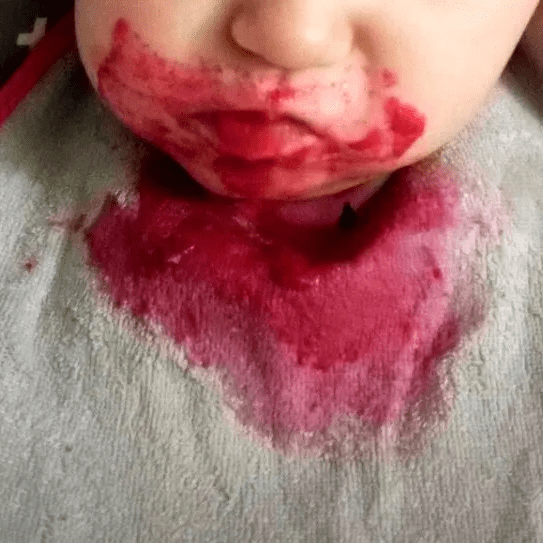
    I thought it was blood at first.

    But the most vibrant kind of blood I had ever seen. Then I remembered what we were feeding the Kartoffel.

    There is a particular shade of magenta that exists nowhere else in the world but on the fingers that have just fed a baby puréed beets. It’s the color of effort and mess and nourishment all at once. A stain that announces itself with all the verve we had even then come to expect from her. One that refuses to be scrubbed away easily. Some days, I would wear this color for hours, having been unable to immediately wash my hands in the small chaos that follows feeding time.

    The beets would stain her lips too, leaving a perfect ring of fuchsia around her mouth like some avant-garde lipstick experiment. Sometimes they’d stain her chin, her bib, shirt, shorts, socks, the walls… Once, a droplet landed on her eyelid when she turned suddenly, giving her the appearance of having applied the world’s tiniest dot of eyeshadow. I chuckled quietly while she gazed at me with disapproving eyes.

    There is intimacy in the way feeding connects two people through substance and sustenance. Her hunger and my response. My offering and her reception. The stains on both our skins telling a story of nourishment exchanged.


    The Origin of Kartoffel

    We called her Kartoffel before we knew there would be words like “hypotonia” and “global developmental delay.” Before geneticists and neurologists and a host of other –ists entered our home with the force of unwanted visitors who nonetheless must be graciously hosted.1

    Kartoffel. Our little potato. Round and soft and warm in those early months, with her cheeks like small pillows and her arms folded close to her chest. There was something so satisfyingly whole about her presence, so complete in her potato-ness. The nickname arrived without much thought, first as a joke, then as a term of endearment whispered against her fontanelle while she slept.

    “Ich liebe dich, meine kleine Süßkartoffel,” I would say lifting her to my face in the mornings:

    I love you, my little sweet potato.

    But the more I used it the more it fit. Potato:

    • humble root vegetable
    • nourishing staple
    • thing that grows quietly underground before being unearthed
    • Thing that transforms with proper tending
    • Thing that persists.

    Plus I find all of the potato-based nicknames cute so it’s a win all around.2 She was a potato before she was a patient. This matters somehow, though I can’t always articulate why. Perhaps because the nickname carved out a space that belonged only to us, a designation that had nothing to do with medical necessity and everything to do with simple, absurd affection.

    Nicknames are curious things. They circumvent official documentation. They refuse clinical precision. They name not the thing itself but the relationship to the thing, the way a person is perceived through the lens of love. It’s something that undeniably refers to her and yet we’ll never see it in a chart or billing sheet. That’s special.


    The Rhythm of Nourishment

    Feeding her was never simple, even before the tube.3 There was always a negotiation happening between her body’s capabilities and her hunger, between our desire to nourish and her ability to receive. But there was joy there, too, in the success of a mealtime where more food went in than came back out. She so loved eating that it was usually our first sign that something was off when she wasn’t enthusiastic about it. Either way it was a sometimes serious, sometimes silly, always sacred thing that I got to do with her.

    The rhythm of it became almost hypnotic. Spoon, mouth, wipe, wait. Spoon, mouth, wipe, wait. Something between a poem and slapstick comedy. Sometimes I would find myself swaying slightly as we sat together, as if keeping time to music only we could hear.

    There are moments in feeding a child when you forget yourself completely. When your attention narrows to just this path of nourishment from bowl to spoon to mouth. When her enjoyment becomes your only metric for success. I took too long in between bites once and she shouted, as if announcing my incompetence to the room, then she eagerly leaned forward for more. In such moments, I too was fed.

    Feeding becomes a conversation without language. Her eyes said yes. Her tongue played translator between the world of flavor and the world of feeling. Her hands conducted an orchestra of enthusiasm or refusal. We developed our own dialect of joy spoken in the language of slipped spoons and nodding into purees.

    The change in how joy must be read came with the silence of the feeding tube.

    We held off on getting the g-tube for years. We were determined that if we just did enough of the right therapy, adjusted the medications just so, and really really really4 wanted her to, she would keep her ability to eat by mouth. But it was taking her hours to finish a few meager ounces, we were exhausted, she choked more than she swallowed, and I have never had a great interest in performing the Heimlich maneuver. She would get the tube.

    I wept.5 Not in front of her, but later, in the shower where crying feels less consequential somehow. It felt like an admission of defeat, though I knew, rationally, it was anything but. It was, in fact, a victory of sorts. We had found another way to give her food and water and medication when the conventional route proved too difficult and too dangerous.

    Yet the intimacy remained, transmuted into new forms. I found myself still talking through meals, still watching her face for signs of satisfaction or discomfort. And we developed new rituals. Venting her upon connection and listening for ‘tummy toots,’ her coughing at just the right moment to shoot stomach fluid into my face, and sometimes I would taste the purées myself, then kiss her cheeks so she could smell the food on my breath.

    I hate beets. Always have. But this is what love looks like to me: becoming the beet-breathed bridge between your child and the experience they cannot access directly. Love is not a spontaneous gift, it doesn’t just happen and its not something you just can’t help but feel. It is intentional. It does not lift us out of our messy imperfect every day life. It digs us further in. Roots us. Covers us in beets.


    The Geography of Care

    There is a peculiar geography to caring for a medically complex child. The landscape is your child’s body, and you must learn its contours with a precision that feels almost invasive. You become a cartographer of breaths and seizures, of bowel movements and skin breakdowns, of the subtle shift in muscle tone that signals distress before any sound emerges.

    The closeness that caregiving demands collapses all traditional boundaries. I know the exact sound of her swallow. I can distinguish between three different types of mucus and maybe twice as many types of poop. I can feel, with my fingertips, the precise spot on her skull where discomfort radiates when her hair is too tight.

    This proximity is both strange and holy. Strange because it defies all normal parameters of relationship, even those between most parents and children. Holy because it consecrates the mundane tasks of care. Suctioning becomes sacred, bathing becomes a blessing, repositioning becomes reverence.

    She knows my hands more than my voice

    This realization came to me one night as I adjusted her sleeping position for perhaps the fifth time. Her body responded to my touch without waking, shifting subtly to accommodate my guidance.

    The clinical narrative attempts to capture her in terms of deficits and diagnoses. But there is another story, told in nicknames and jokes and food stains. This counter-narrative reminds us that she also:

    • responds to music
    • laughs at her uncles’ antics6
    • communicates displeasure with remarkable clarity and precision for someone without words (usually directed at me)

    I have learned to read her without words. Without typical cries. Without the usual landmarks of development that guide most parents. Instead, I read micro-expressions, the tension in shoulders, the pattern of eye movements. This, too, is a form of literacy.


    Colors of Memory

    Recently she wore a shirt the exact color of beets. I didn’t choose it for this reason it was simply what was clean and weather-appropriate, but when I saw her in it, reflected in the car window as we packed up for therapy, the symmetry struck me. The deep magenta fabric against her pale skin, like those stained lips from years ago.

    Sometimes memory arrives not as story but as color, as sense-echo from a previous version of your life. The shirt reminded me of all those feeding sessions, all those stained fingers, all those moments of connection through nourishment. All of those thousands of hours of pleading with her, myself, and the Choir Invisible that she would be able to swallow just one more bite.

    Last semester, I found a smudge of something purple on my sleeve after work. For a brief, disorienting moment, I thought it was beet purée from years ago, somehow preserved in fabric despite countless washings. It was actually ink from a leaky pen7 but the momentary confusion created a wrinkle in time where past and present overlapped.

    I’ve had dreams where she’s chewing. Ordinary dreams where we sit at a table and she eats pizza or apples or birthday cake. I always wake from these with a complicated feeling. Not quite sadness, not quite longing, but a peculiar awareness of parallel lives, of what might have been alongside what is.

    In the world we actually inhabit, I say “Kartoffel” and she turns her head toward the sound. Not every time, her responses fluctuate with her energy and how much I’ve pissed her off that day, but often enough that it feels like recognition. The nickname has roots. So does she.

    There is an argument to be made that all intimacy involves some sort of loss. The loss of separateness, the loss of certain freedoms, the loss of who you thought you might be before this love arrived. But intimacy is also about what persists and reshapes itself around new realities. It’s about finding connection within the limitations, in the creative adaptations they demand.

    I used to feed her beets with a spoon. Now I feed her formula through a tube. But still, every day, she eats something of me. My attention. My care. My continuous presence. And I, in turn, am filled by her existence—by the way she has expanded my understanding of what it means to communicate, to adapt, and to love.

    The beet stains linger, just like the nickname. Neither was part of the plan. Both are part of the story.

    Cheers,

    [kartoffelvater]

    I hope you enjoyed this post. Don’t forget to check out the original article over at The Memoirist, a fantastic resource for exploring the creative stories unpacked from the nostalgic hope chests of our lives. Be sure to visit them!

    Did this newsletter resonate with you? Reply with your thoughts or share your own story. And if you know someone who might need these words today, please forward this along.

    We wouldn’t be here without you. Every bit of support helps and we appreciate it more than words can say!
    1. Something I think about often is just how much our ‘circle’ has grown with professionals. Growing up there was only 1 or 2 people who had become ‘part of the family’ that weren’t life-long friends of my parents or neighbors (I feel particularly lucky that I have always had the most excellent neighbors, even to this day). But with the Kartoffel, there are so many doctors, nurses, therapists, administrators, you name it, who aren’t just ‘part of her care team’ they have become closer to us than some actual family members. Hmm, definitely want to write more about this… ↩︎
    2. Tater, Tater Tot, Tot, Tatie, Tottie, Murph, Murphy, Spud, Spuddy, Spuddy Buddy, Spudnik, Tuber, Mash, Petite Patate, Chip, Couch Potato, Hot Potato, Sweet Potato, Fry, Small Fry, Salty Fry, Crinkle Fry, Soggy Fry, Russet, Red, The Great Yukon, Yukon-Do It, Yukonovich, Idaho, Pomme…we are accepting more if you have them please email us. ↩︎
    3. Not the time for it, but our post-natal care was…subpar…and part of that was due to the lackluster support around feeding the Kartoffel which resulted in our OB-GYN yelling at the staff in the hall for taking such terrible care of us. With this, and one other, exception we have had absolutely excellent nurses. I’m not a yeller, and normally don’t condone it, but whew, when a medical professional full-throatedly yells at other professionals to be better humans and care for patients as people not just numbers on a chart, it is a thing to behold. ↩︎
    4. Hope so often finds itself adrift between fantasy and despair and in so doing we end up mistaking desire for determination. ↩︎
    5. I do, and have over the years done, this a lot. So much, in fact, that my eyes have developed a condition where they do not produce their own oil anymore. When I saw my ophthalmologist about it she said, “Sometimes this can happen if you cry a lot. Have you had reason to be crying much these past years?” She obviously was not familiar with my work, aka the work of love that it is to have a child like the Kartoffel. I find myself blinking more frequently than normal and also find particles stuck in my eyes often. But what am I going to do, cry about it? It wouldn’t help even if I did. But also, yes I still weep, frequently. ↩︎
    6. If there is one thing she has been blessed with an abundance of it is uncles who are rowdy, raucous, and entirely devoted to her. Very few things on Earth get her happy attention more than her uncles, and I’m not sure who loves who more. ↩︎
    7. I enjoy the actual act of writing, not just the spirit of it, alas my penmanship is far outstripped by the quality of who I write about most often. I compensate by buying pens and notebooks and leaving pens in pockets and am rewarded by frequent leaks from said pens. ↩︎
  • A Different Planet

    On Epistemic Isolation in the Bureaucracy of Care

    Let me tell you about Wednesday.

    Just Wednesday of last week.1 I spent three hours on the phone, mostly on hold, listening to the same tinny muzak interrupted periodically by a robotic voice assuring me that my call was important. All while my daughter’s pulse ox alarmed in the background.

    The shrill beeping was like a smoke detector with a vendetta. I paced between her room and the kitchen, the call sent to my headphones so I could still use my hands, toggling between menus on my phone screen. When I finally reached a human voice, they asked me for my daughter’s birth date three times and then transferred me. Again.

    I was trying to resolve a denied claim for a medication my child needs daily. Denied because someone somewhere typed a wrong digit into a system. As I waited, I scrolled through emails, found two new forms to complete for durable medical equipment and a notice that our previous authorization for therapy was expiring. All this before I had even properly caffeinated myself for the day ahead.

    Does anyone else feel like they’re living in some parallel dimension2 when dealing with these systems? A dimension where time stretches and contracts unpredictably, where logic operates by different rules, and where the most fundamental human concerns like a child’s health or a family’s stability seem bizarrely abstract to the gatekeepers of resources?


    The Theater of Bureaucracy

    There’s something almost theatrical about these calls. They ask for a case number you were never given, or send an approval letter for a medication your doctor never requested but a denial for the one they did. It’s logistical whiplash. You know something about your child—deeply, bodily—and the system acts as if that knowledge is either irrelevant or incorrect.

    The experience reminds me of those philosophical terms I used to read3 and now live: epistemic isolation—a form of estrangement rooted not in how far apart we are, but in how and what we know.

    At some point, we became accidental experts. I can now differentiate between CPT and ICD-10 codes. I know the hold music of three major pharmacies by heart. These are not the kinds of facts I wanted to carry but I do, folded in with the weight of feeding schedules and seizure logs.

    The true irony is that this hard-won knowledge separates me further from those who should theoretically help us navigate these systems.

    I’ve had the surreal experience of explaining coverage policies to insurance representatives, citing specific provisions they seemed unaware existed. In gaining this expertise, I’ve become something of an alien, speaking a dialect that even the native bureaucrats find unfamiliar. The more we know, the harder it becomes to explain to others who don’t4 live this way.

    It’s like becoming bilingual in a language no one else speaks back.


    The Untranslatable Reality

    What’s harder to convey, what seems genuinely untranslatable, is the lived reality beneath these administrative struggles. There’s no box on the form for “I haven’t slept through the night in years.” No checkmark for “My daughter is nonverbal but lights up when she hears the sound of mama’s voice.”

    How do I explain to the clerk processing our application that I completed her forms while sitting on the bedroom floor monitoring her temperature? How do I convey to the insurance reviewer that the treatment they’ve deemed “not medically necessary” is the only thing that allowed my kid to laugh again after months of pain? What does “necessity” even mean to someone who’s never suctioned their child’s airway in the dead of the night? Who’s never watched the life drain slowly from their spouse’s eyes as they read another denial letter?

    Sometimes I imagine what our life looks like from the outside. A stack of labeled folders, a wall calendar peppered with acronyms. A father on speakerphone waiting for someone to believe him.

    What’s invisible is the tiny, precise tenderness required to keep our daughter safe: warming her formula to the exact degree, timing meds down to the minute, understanding the shift in her breath before a seizure.

    These are things you can’t write on a form. They are lived knowledge. A real, aching, daily dose of quiddity. But to the system, they’re noise. Background.


    Between Planets

    There’s a moment—maybe familiar—when you’re trying to explain, again, to a new person why your child needs something, and you realize: they’re not even on the same planet. Not metaphorically. Not emotionally. Epistemically.

    They don’t share your frame of reference. What feels urgent to you is procedural to them. What is survival to you is a policy to be followed. You’re not just misunderstood. You’re unknowable.

    I’ve watched friends’ eyes glaze over when I start explaining our latest administrative nightmare. I’ve endured well-meaning suggestions that betray a fundamental misunderstanding:

    • “Have you contacted your case manager?” (Only weekly for the past three years)
    • “There must be a program for that!” (There is; we don’t qualify for reasons that defy logic)
    • “Oh [so-and-so] had that happen to them, they just called and fix it right away!”
    • “Have you tried [insert some medication they heard about on a podcast]?”
    • “Remember to take care of yourself, you can’t pour from an empty cup!”

    Yeah, but you can’t fill a broken one, either.

    This kind of isolation is exhausting. It’s one thing to be unseen. It’s another to be seen inaccurately, again and again, by the very people you turn to for support. To have your reality mistranslated into metrics and platitudes.


    The Loneliness of Insight

    You start to notice things that at first blush seem like they should be wild conspiracies.

    Those of us parenting medically complex children see shadows on the wall5 that others don’t, or can’t, or won’t. Patterns in these sanguinary systems that become glaringly obvious once you’ve spent years entangled in them. We understand that policies labeled as “patient-centered” were clearly written without a single actual patient in the room. Procedures allegedly designed for efficiency primarily serve to ration resources through attrition and exhaustion. Paperwork is designed to stall. Denials come faster than approvals.

    At one point after our nth hospitalization for a particular illness, the Kartoffel finally qualified for a particular medical device. Exasperated, we asked a healthcare professional, “Surely it would be cheaper for insurance to provide the device preventatively, especially for a case like hers where the likelihood that she would need the device was just shy of definitively, instead of having to pay for multiple long hospital stays and the device anyway?” “No,” she responded, and explained to us that as counterintuitive as it seems insurance isn’t in the business of saving money, it is in the business of making money. And those are very different things. If they give you the device preventatively sure it saves them a little in the short run, but if they have to pay out for multiple hospitals stays and the device and most likely more hospital stays because they made you wait years and now your daughter is permanently compromised, then they get to raise premium for every single one of their members. Our stays and device costs them tens of thousands of dollars, but then they get to charge tens of millions more from everybody else.5

    Compliance over Care

    We see all this plainly, while others—even well-meaning professionals within these systems—seem to perceive only the official narratives about how things should work rather than how they actually do. Seeing these patterns doesn’t bring comfort. It makes the gap wider.

    There’s a specific hue of loneliness in this insight. It’s like being the only person who can see a color that lacks a name, trying desperately to describe it to a room full of people who insist it doesn’t exist.

    We are trying to navigate a system that was not made for us. Or maybe it was—and that’s the terrifying part.


    Finding Our Language Again

    There is a new grammar I’ve gathered from my years in this parallel dimension:

    • Document everything: conversations, who you spoke to, denials, approvals, hell even what hold music was playing.
    • Find allies within the system; there are compassionate individuals embedded in even the most heartless bureaucracies.
    • Develop a philosophical perspective that allows you to see these struggles as separate from your worth as a parent or your child’s value as a human being.
    • And when possible, step away from the paperwork long enough to remember why you’re fighting so hard in the first place—to see your child as more than a collection of diagnoses and needs.

    To this end I try to carve out moments to connect with the world beyond medical forms and insurance appeals. I read novels that have nothing to do with healthcare. I get outside as often as I can, finding in growing things a reminder that nature operates by different rules than human bureaucracies. I try, however imperfectly, to maintain friendships with people who know me as more than “parent of patient #487-29B.”

    Perhaps one day these systems will evolve to better reflect the realities of those they serve. Or perhaps one day these systems will be completely obliterated, and we will have to throw our baby out with the proverbial bathwater.6 Until then, we persist and become reluctant experts, finding community where we can. Other parents are out here—on hold, in waiting rooms, fighting the same fight. When I share these stories, they nod before I finish the sentence. There’s a brief exhale, a knowing look.

    And that’s the strange hope: our isolation isn’t unique. Which means it isn’t total.

    Sometimes connection begins not in acicular nature of answers, but in shared bewilderment. In hearing someone else say, “Yeah, it feels like a different planet to me, too.”

    And from a place within the mess we begin to find our language again. Language that doesn’t flatten our lives but stretches to hold their weight.

    Cheers,

    kartoffelvater


    Did this newsletter resonate with you? Reply with your thoughts or share your own story. And if you know someone who might need these words today, please forward this along.

    We wouldn’t be here without you. Every bit of support helps and we appreciate it more than words can say!
    Buy me a coffee!


    1. Honestly you could cover your eyes, throw a dart at a calendar, and you’d land on a day similar to this one. ↩︎
    2. Or in a dystopian novel, if you’ve spent any amount of time watching the news or reading the comments section. ↩︎
    3. This is going to happen a lot, but I understand that approximately zero of you signed up for a philosophy newsletter and rightfully so, those are awfully dull (; ). I’ll do my best to put the concepts into narratives, but every now and then a term or two is going to slip out. ↩︎
    4. And shouldn’t have to. No one should live this way; this isn’t a way of living it’s a simulation of simulated lives wrapped up in red tape. ↩︎
    5. I’m being cagey with some of the details on purpose (like the device, the illness, and the position of the healthcare professional) because I have a healthy distrust of people who are in the business of making money off of the suffering of children and don’t want the device taken away or the professional to be fired. Another family got this same device before a single hospitalization for (not) said illness, because again, it’s not about making sense, it’s about making money. ↩︎
    6. This post was not written in regard to a certain piece of recent legislature that has been much talked about in disability, and many other, communities (and anyone reading it as such is doing so of their own volition) but it easily could have been. One theory says all anxiety comes down to two base fears: separation and annihilation. This post deals with the former whereas to fully unwrap the reactions I see and feel about the bill I would need to explore the latter. Maybe next time. ↩︎