Finding connection through stained fingers and feeding tubes
Thank you for coming back, or for finding your way here for the first time. However you arrived—I’m so glad you’re here.
This was originally published in The Memoirist, my Medium friends can read this story over there as well.
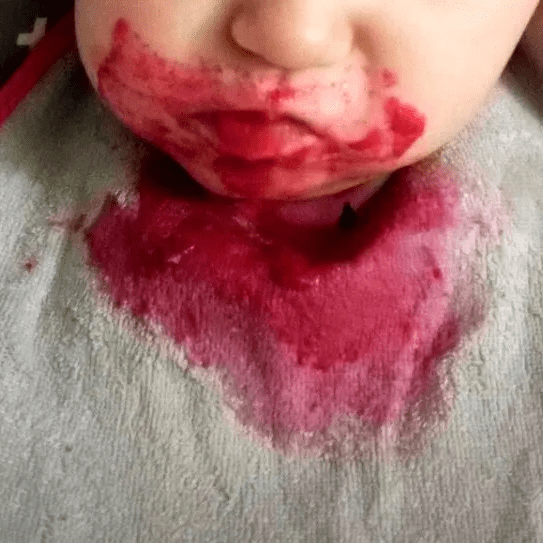
I thought it was blood at first.
But the most vibrant kind of blood I had ever seen. Then I remembered what we were feeding the Kartoffel.
There is a particular shade of magenta that exists nowhere else in the world but on the fingers that have just fed a baby puréed beets. It’s the color of effort and mess and nourishment all at once. A stain that announces itself with all the verve we had even then come to expect from her. One that refuses to be scrubbed away easily. Some days, I would wear this color for hours, having been unable to immediately wash my hands in the small chaos that follows feeding time.
The beets would stain her lips too, leaving a perfect ring of fuchsia around her mouth like some avant-garde lipstick experiment. Sometimes they’d stain her chin, her bib, shirt, shorts, socks, the walls… Once, a droplet landed on her eyelid when she turned suddenly, giving her the appearance of having applied the world’s tiniest dot of eyeshadow. I chuckled quietly while she gazed at me with disapproving eyes.
There is intimacy in the way feeding connects two people through substance and sustenance. Her hunger and my response. My offering and her reception. The stains on both our skins telling a story of nourishment exchanged.
The Origin of Kartoffel
We called her Kartoffel before we knew there would be words like “hypotonia” and “global developmental delay.” Before geneticists and neurologists and a host of other –ists entered our home with the force of unwanted visitors who nonetheless must be graciously hosted.1
Kartoffel. Our little potato. Round and soft and warm in those early months, with her cheeks like small pillows and her arms folded close to her chest. There was something so satisfyingly whole about her presence, so complete in her potato-ness. The nickname arrived without much thought, first as a joke, then as a term of endearment whispered against her fontanelle while she slept.
“Ich liebe dich, meine kleine Süßkartoffel,” I would say lifting her to my face in the mornings:
I love you, my little sweet potato.
But the more I used it the more it fit. Potato:
- humble root vegetable
- nourishing staple
- thing that grows quietly underground before being unearthed
- Thing that transforms with proper tending
- Thing that persists.
Plus I find all of the potato-based nicknames cute so it’s a win all around.2 She was a potato before she was a patient. This matters somehow, though I can’t always articulate why. Perhaps because the nickname carved out a space that belonged only to us, a designation that had nothing to do with medical necessity and everything to do with simple, absurd affection.
Nicknames are curious things. They circumvent official documentation. They refuse clinical precision. They name not the thing itself but the relationship to the thing, the way a person is perceived through the lens of love. It’s something that undeniably refers to her and yet we’ll never see it in a chart or billing sheet. That’s special.
The Rhythm of Nourishment
Feeding her was never simple, even before the tube.3 There was always a negotiation happening between her body’s capabilities and her hunger, between our desire to nourish and her ability to receive. But there was joy there, too, in the success of a mealtime where more food went in than came back out. She so loved eating that it was usually our first sign that something was off when she wasn’t enthusiastic about it. Either way it was a sometimes serious, sometimes silly, always sacred thing that I got to do with her.
The rhythm of it became almost hypnotic. Spoon, mouth, wipe, wait. Spoon, mouth, wipe, wait. Something between a poem and slapstick comedy. Sometimes I would find myself swaying slightly as we sat together, as if keeping time to music only we could hear.
There are moments in feeding a child when you forget yourself completely. When your attention narrows to just this path of nourishment from bowl to spoon to mouth. When her enjoyment becomes your only metric for success. I took too long in between bites once and she shouted, as if announcing my incompetence to the room, then she eagerly leaned forward for more. In such moments, I too was fed.
Feeding becomes a conversation without language. Her eyes said yes. Her tongue played translator between the world of flavor and the world of feeling. Her hands conducted an orchestra of enthusiasm or refusal. We developed our own dialect of joy spoken in the language of slipped spoons and nodding into purees.
The change in how joy must be read came with the silence of the feeding tube.
We held off on getting the g-tube for years. We were determined that if we just did enough of the right therapy, adjusted the medications just so, and really really really4 wanted her to, she would keep her ability to eat by mouth. But it was taking her hours to finish a few meager ounces, we were exhausted, she choked more than she swallowed, and I have never had a great interest in performing the Heimlich maneuver. She would get the tube.
I wept.5 Not in front of her, but later, in the shower where crying feels less consequential somehow. It felt like an admission of defeat, though I knew, rationally, it was anything but. It was, in fact, a victory of sorts. We had found another way to give her food and water and medication when the conventional route proved too difficult and too dangerous.
Yet the intimacy remained, transmuted into new forms. I found myself still talking through meals, still watching her face for signs of satisfaction or discomfort. And we developed new rituals. Venting her upon connection and listening for ‘tummy toots,’ her coughing at just the right moment to shoot stomach fluid into my face, and sometimes I would taste the purées myself, then kiss her cheeks so she could smell the food on my breath.
I hate beets. Always have. But this is what love looks like to me: becoming the beet-breathed bridge between your child and the experience they cannot access directly. Love is not a spontaneous gift, it doesn’t just happen and its not something you just can’t help but feel. It is intentional. It does not lift us out of our messy imperfect every day life. It digs us further in. Roots us. Covers us in beets.
The Geography of Care
There is a peculiar geography to caring for a medically complex child. The landscape is your child’s body, and you must learn its contours with a precision that feels almost invasive. You become a cartographer of breaths and seizures, of bowel movements and skin breakdowns, of the subtle shift in muscle tone that signals distress before any sound emerges.
The closeness that caregiving demands collapses all traditional boundaries. I know the exact sound of her swallow. I can distinguish between three different types of mucus and maybe twice as many types of poop. I can feel, with my fingertips, the precise spot on her skull where discomfort radiates when her hair is too tight.
This proximity is both strange and holy. Strange because it defies all normal parameters of relationship, even those between most parents and children. Holy because it consecrates the mundane tasks of care. Suctioning becomes sacred, bathing becomes a blessing, repositioning becomes reverence.
She knows my hands more than my voice
This realization came to me one night as I adjusted her sleeping position for perhaps the fifth time. Her body responded to my touch without waking, shifting subtly to accommodate my guidance.
The clinical narrative attempts to capture her in terms of deficits and diagnoses. But there is another story, told in nicknames and jokes and food stains. This counter-narrative reminds us that she also:
- responds to music
- laughs at her uncles’ antics6
- communicates displeasure with remarkable clarity and precision for someone without words (usually directed at me)
I have learned to read her without words. Without typical cries. Without the usual landmarks of development that guide most parents. Instead, I read micro-expressions, the tension in shoulders, the pattern of eye movements. This, too, is a form of literacy.
Colors of Memory
Recently she wore a shirt the exact color of beets. I didn’t choose it for this reason it was simply what was clean and weather-appropriate, but when I saw her in it, reflected in the car window as we packed up for therapy, the symmetry struck me. The deep magenta fabric against her pale skin, like those stained lips from years ago.
Sometimes memory arrives not as story but as color, as sense-echo from a previous version of your life. The shirt reminded me of all those feeding sessions, all those stained fingers, all those moments of connection through nourishment. All of those thousands of hours of pleading with her, myself, and the Choir Invisible that she would be able to swallow just one more bite.
Last semester, I found a smudge of something purple on my sleeve after work. For a brief, disorienting moment, I thought it was beet purée from years ago, somehow preserved in fabric despite countless washings. It was actually ink from a leaky pen7 but the momentary confusion created a wrinkle in time where past and present overlapped.
I’ve had dreams where she’s chewing. Ordinary dreams where we sit at a table and she eats pizza or apples or birthday cake. I always wake from these with a complicated feeling. Not quite sadness, not quite longing, but a peculiar awareness of parallel lives, of what might have been alongside what is.
In the world we actually inhabit, I say “Kartoffel” and she turns her head toward the sound. Not every time, her responses fluctuate with her energy and how much I’ve pissed her off that day, but often enough that it feels like recognition. The nickname has roots. So does she.
There is an argument to be made that all intimacy involves some sort of loss. The loss of separateness, the loss of certain freedoms, the loss of who you thought you might be before this love arrived. But intimacy is also about what persists and reshapes itself around new realities. It’s about finding connection within the limitations, in the creative adaptations they demand.
I used to feed her beets with a spoon. Now I feed her formula through a tube. But still, every day, she eats something of me. My attention. My care. My continuous presence. And I, in turn, am filled by her existence—by the way she has expanded my understanding of what it means to communicate, to adapt, and to love.
The beet stains linger, just like the nickname. Neither was part of the plan. Both are part of the story.
Cheers,
[kartoffelvater]
I hope you enjoyed this post. Don’t forget to check out the original article over at The Memoirist, a fantastic resource for exploring the creative stories unpacked from the nostalgic hope chests of our lives. Be sure to visit them!
Did this newsletter resonate with you? Reply with your thoughts or share your own story. And if you know someone who might need these words today, please forward this along.
We wouldn’t be here without you. Every bit of support helps and we appreciate it more than words can say!
- Something I think about often is just how much our ‘circle’ has grown with professionals. Growing up there was only 1 or 2 people who had become ‘part of the family’ that weren’t life-long friends of my parents or neighbors (I feel particularly lucky that I have always had the most excellent neighbors, even to this day). But with the Kartoffel, there are so many doctors, nurses, therapists, administrators, you name it, who aren’t just ‘part of her care team’ they have become closer to us than some actual family members. Hmm, definitely want to write more about this… ↩︎
- Tater, Tater Tot, Tot, Tatie, Tottie, Murph, Murphy, Spud, Spuddy, Spuddy Buddy, Spudnik, Tuber, Mash, Petite Patate, Chip, Couch Potato, Hot Potato, Sweet Potato, Fry, Small Fry, Salty Fry, Crinkle Fry, Soggy Fry, Russet, Red, The Great Yukon, Yukon-Do It, Yukonovich, Idaho, Pomme…we are accepting more if you have them please email us. ↩︎
- Not the time for it, but our post-natal care was…subpar…and part of that was due to the lackluster support around feeding the Kartoffel which resulted in our OB-GYN yelling at the staff in the hall for taking such terrible care of us. With this, and one other, exception we have had absolutely excellent nurses. I’m not a yeller, and normally don’t condone it, but whew, when a medical professional full-throatedly yells at other professionals to be better humans and care for patients as people not just numbers on a chart, it is a thing to behold. ↩︎
- Hope so often finds itself adrift between fantasy and despair and in so doing we end up mistaking desire for determination. ↩︎
- I do, and have over the years done, this a lot. So much, in fact, that my eyes have developed a condition where they do not produce their own oil anymore. When I saw my ophthalmologist about it she said, “Sometimes this can happen if you cry a lot. Have you had reason to be crying much these past years?” She obviously was not familiar with my work, aka the work of love that it is to have a child like the Kartoffel. I find myself blinking more frequently than normal and also find particles stuck in my eyes often. But what am I going to do, cry about it? It wouldn’t help even if I did. But also, yes I still weep, frequently. ↩︎
- If there is one thing she has been blessed with an abundance of it is uncles who are rowdy, raucous, and entirely devoted to her. Very few things on Earth get her happy attention more than her uncles, and I’m not sure who loves who more. ↩︎
- I enjoy the actual act of writing, not just the spirit of it, alas my penmanship is far outstripped by the quality of who I write about most often. I compensate by buying pens and notebooks and leaving pens in pockets and am rewarded by frequent leaks from said pens. ↩︎
 Our Little Kartoffel