Why cry over parts of life when all of it calls for tears?
Part IV: Creation
Thank you for coming back, or for finding your way here for the first time. However you arrived—I’m so glad you’re here.
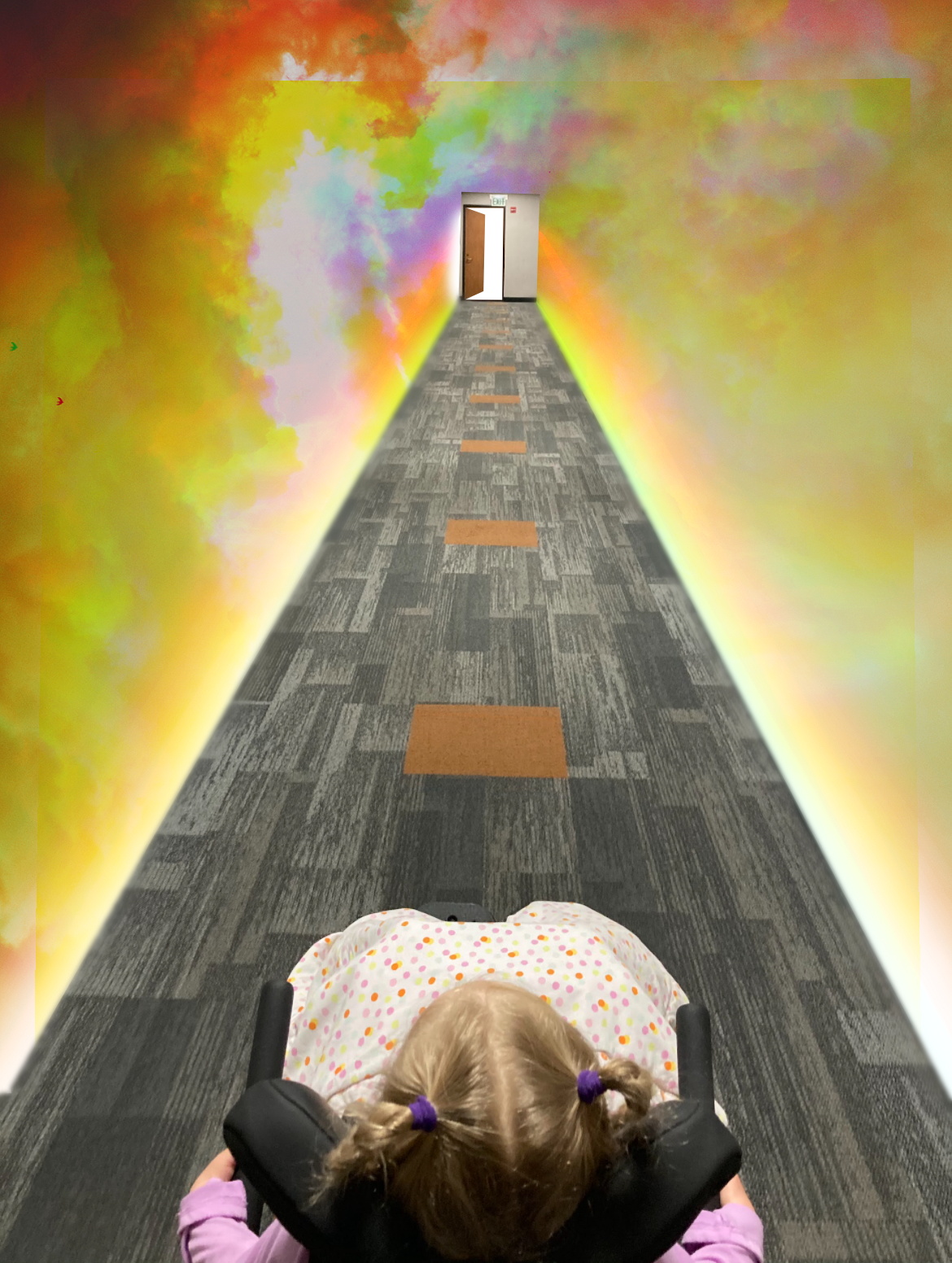
Hallo Kartoffelkumpel,
Last time, I told the story of the diagnosis as it first arrived: the room, the ritual, the collapse of assumed futures. But that collapse wasn’t the end. It was the beginning of a different way of seeing, one that unfolded slowly, not in a single revelation but in a repeated clearing. This fourth part turns toward that reframing: the shift from categories to presence, from interpretation to attention, from projection to companionship.1
The Reframe
She already knew this part of her story.
It had been written, long before they named it, in the spiral of her DNA, in the pulse of her seizures, in the particular way her eyes followed light and lingered in corners most people forget to look in.2 Her body was not waiting for a diagnosis to begin. She had been composing herself all along, in her own cells and reflexes, in her own mystery and music.
The diagnosis wasn’t the start of something going wrong. It was the moment I realized that I had been trying to read her in the wrong language. Not because their words were false, but because no single vocabulary could hold her. The medical terms carried information that is useful, even life-saving, but they were written in a dialect that flattened mystery into measurement.
She had been speaking all along, but not in speech or in symbols easily translatable. Her story was being told in her gaze,3 in the pause that came before her movements, in the way her breath caught slightly when something unfamiliar entered the room. I had to learn a new kind of reading. A reading that didn’t seek to decode but to dwell. A slower, less certain form of knowing. This wasn’t interpretation in the usual sense. It was presence. Attention. A kind of looking that lets meaning arrive down the river of life without damming everything up to get it to stop moving.
There’s a scent that still takes me there. Faint, sweet, the unmistakable blend of antiseptic wipes and liquid medications with names I had to learn how to pronounce. At first, I thought it smelled like illness. But that was just habit. It’s not the smell of pathology. It’s the signature of her body’s particular way of being in the world. The smell of her dwelling. Not a broken body. Just hers.
The more I stepped outside their categories, the more I could see her. Not a symptom cluster, not a case study, but a person with her own splash of watery logic. Her own tempo. Her own kind of sense-making. It’s not that I believe the medical team was wrong.4 Many were kind, most were precise. Their language can do important things like initiate care plans, organize teams, open doors to resources and communities. But correctness is only one face of that gem we call truth.
She is another face.
The diagnosis is a tool. And like all tools, it can build or destroy. It can cut a path or narrow a view. When it leads us away from her into prognosis charts and comparative graphs, into fear or exclusion it becomes a covering. A veil. But when it brings us closer, when it becomes a way of naming without reducing, of pointing toward without containing, it becomes a means of disclosure. A way into authentic encounter.
She does not move by the tyranny of developmental timelines. She moves according to her own rhythm that bends clocks, reorders days, unsettles categories. And if I let go of the need to measure I can learn to move with her.
This is what was really being revealed when we moved from assumptions to categories and now to an understanding that this was never about fixing her. It was about learning how to see her.
The Creation
They looked at us as if the ending had already been written, but her fierce eyes were writing a different myth.
Not tragic in the way they meant—some cautionary tale to be met with sorrow and sidelong glances—but tragic in the oldest sense: ontologically consequential.5 Her presence discloses a world while her being rearranges the space around her.
From the clearing left behind by discarded assumptions, new forms of life began to take root, new ways of being-with emerged. Not heroic or inspirational in the way people mean it in on social media. Just new. Attention became something else entirely. It was no longer the scanning kind that is always measuring, anticipating, comparing. It became a sort of habitat. Attention as tending to. Witnessing. An open stance for a gesture, a sound, a silence that might mean everything or nothing, and staying with it either way.
Care, too, changed shape. It stopped being about fixing, optimizing, progressing. It became more like attunement, like standing in a forest long enough for your eyes to adjust to the subtle movement of branches. We began building rituals, not to bring her up to our pace, but to meet her in hers. Therapies still happened. Medications still mattered. But they were no longer the horizon. The destination was no longer normalization or representation or acceptance.6
It was her. Us. Our lives together.
I didn’t plan then that stroller walks would become exercises in authentic temporality, moving according to her rather than imposed schedules, but that’s what they became. A way of inhabiting time that had less to do with clocks and more to do with companionship. With noticing. With letting the world arrive rather than always rushing toward it.
And here is where she began to challenge things I didn’t know I still believed. About autonomy. About progress. About worth. About what makes a life meaningful.
Her way of being insists on a deeper definition of life. One that doesn’t begin with independence or end with achievement. One that starts instead with connection, with the kind of knowing that doesn’t ask for proof. A relationship without expectation beyond evidence of my affection, and knowing even then that love without reward can have value and bring meaning.
This wasn’t the creation of a new normal. It was the beginning of something truer than normal ever was.
Living Inside Authentic Understanding
This is not an arrival.
Authentic understanding isn’t something you reach and hold. It’s something you return to again and again and again and twice more again as the layers of interpretation, fear, and projection slowly peel away, fold back onto you, and peel away again.
Every child arrives with their own mythology. A way of being that often contradicts the categories we’re handed. But some children make that contradiction more visible. They carry it in their eyes, in their bodies, in the ways they refuse the usual arc of progress.
She did not come to teach me a lesson. But living with her is not just parenting, it’s an ongoing education. I have learned to question what I thought I knew about time, about care, about value. She undoes those inherited logics not with argument, but with…something I’m still trying to figure out.
The diagnosis scene wasn’t an ending. It wasn’t even a rupture in the way I first imagined. It was a threshold. Not into despair, but into a deeper encounter with what is. A shift from reading the data of life to reading the her-ness of life. An opening to loving the whole of her life and not just the sweetness of it.
And each day, that work begins again as she reorients me away from metrics and toward herself. Away from the future tense and into now.
Because the categories accumulate quickly—well-meaning advice, comparisons, progress updates, the quiet internal voice that still asks, “Is she improving?”—each day, I have to clear space again. To set aside what I think I know. To resist the urge to measure, to explain, to translate, to look for her getting ‘better’.7
Instead, I try to be with her. To notice. To let meaning emerge without forcing it into form. She is not a puzzle to solve. She is a whole universe to experience. And when I look now at those dust motes in the sunlight, I see they haven’t changed.
The light is the same. But I can see it differently.
It doesn’t illuminate in the way I once thought by casting light onto things from the outside, explaining them.
It reveals.
And what it reveals was always already there. Waiting.
Until next time stay safe, stay kind, and know that you are appreciated.
Cheers,
[kartoffelvater]
Did this newsletter resonate with you? Reply with your thoughts or share your own story. And if you know someone who might need these words today, please forward this along.
We wouldn’t be here without you. Every bit of support helps and we appreciate it more than words can say!
The subtitle of this post is paraphrasing a quote from Seneca:
Why need we weep over parts of our life? the whole of it calls for tears: new miseries assail us before we have freed ourselves from the old ones.
I had it picked out before the events of this past week. Those who have chatted with me about my philosophical inclinations probably can guess how I interpret it and why I chose it. You are of course welcome to interpret it as you wish, and I would love to hear what you think.
The amount of times my stomach dropped because she suddenly looks at a dark corner of the ceiling is absurd.
And now, thanks to the incredible efforts of her therapist, her gaze is literally telling us her story. More on that later. Spoilers, she’s got a lot of sassitude.
Again, this is not a case of ‘how dare they put a limit on what my child can do!’ because, as you’ll remember, we asked for this information with far more enthusiasm than they gave it to us.
I really try to not use jargon, but ‘ontological’ is a word that just feels good to say for me. Basically what I’m saying here is that tragedy is an important concept for understanding who she is. See here and here (that second one was published but not emailed so it might be new for you!) and if you got the time for a deeper dive check this one out.
Acceptance is not, cannot be, the goal. It is not a skill you learn or practice. It’s not something on a checklist that you grow strong enough to check off. You don’t grow into acceptance, it grows out of you. It’s an orientation of your Being, a way of relating to the facts of your ‘here-ness’. Acceptance comes from engagement with, not detachment from, the hard bits of your life. It is the bloom that unfolds out of the richness of experience, not the limiting of it. Acceptance, like Hope, is found in the mud made from the tears of an intentional existence. It is the sweaty residue of authenticity that drips off of your soul.
Some parents have a broadening of their idea of ‘better’ aided by the progress of their child, regardless of how incremental that progress is. They learn that ‘better’ can mean many things across as many situations as their child’s progress exposes them to.
Other parents have a deepening of their idea of ‘better’ aided by the persistent decline of their child. ‘Better’ doesn’t mean more things than before but rather becomes something nuanced and complex.
The real work begins when you examine your need for things to get better.
 Our Little Kartoffel
Leave a comment