On Halloween Costumes and Other Performances
Thank you for coming back—or for finding your way here for the first time. However you arrived, I’m glad you’re here.
Hallo Kartoffelkumpel,
We’ve had a strange little stretch here. One of those weeks where time feels like it’s wearing someone else’s coat. Too big in some places, too tight in others. Mornings come with the weight of unspoken expectations, and evenings vanish in a puff of undone tasks. Still, in the middle of it all, there are these small, theatrical moments that shimmer oddly. Maybe that’s what nudged these memories loose. That and the fact it was Halloween…
The fabric rustled like a breeze through dry leaves.
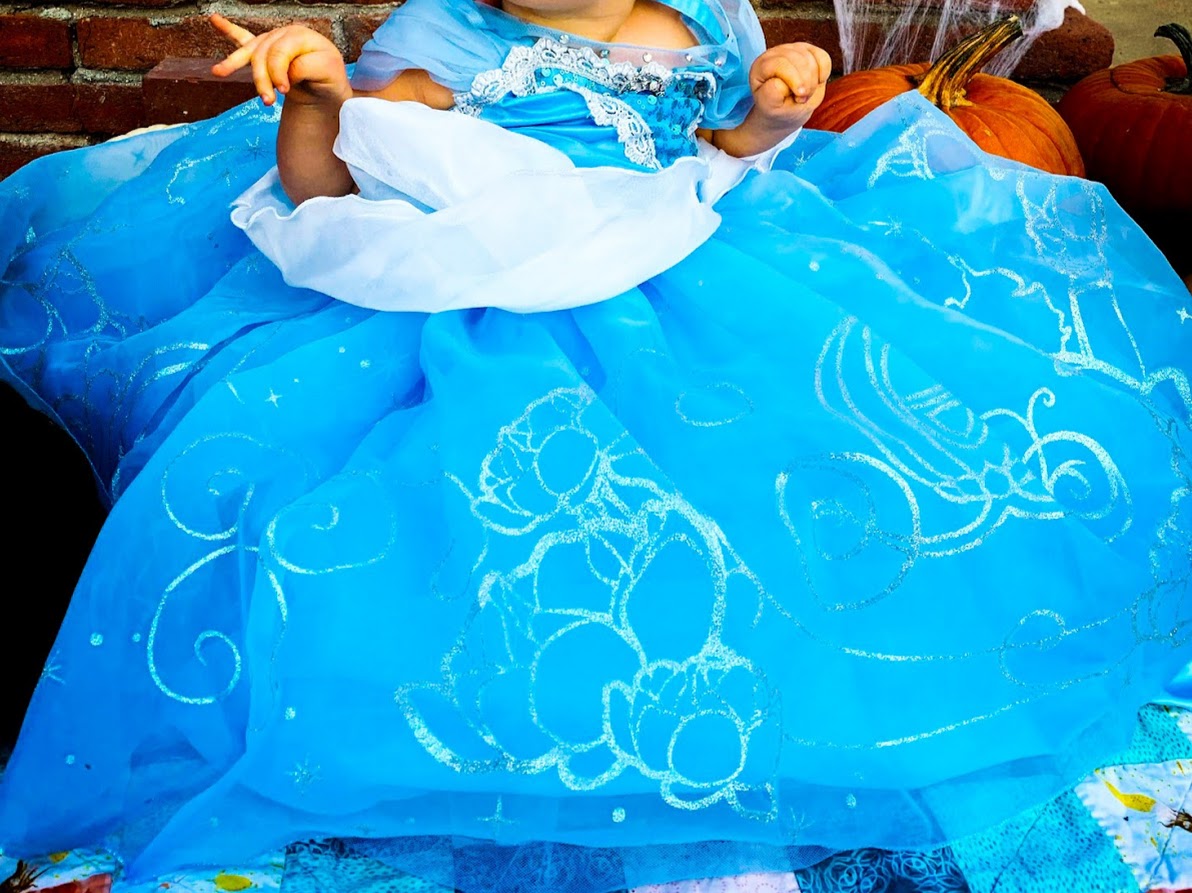
Sharp and insistent it was a little too loud for such a quiet afternoon. The Kartoffel’s Cinderella gown shimmered faintly in the soft October light, all satin and tulle and imagined grandeur. The skirt alone was enough to overwhelm a small living room, let alone a child who spends most of her time outdoors strapped into a medical chair. We crouched beside her, maneuvering the layers around her arms and legs, trying not to jostle her too-vulnerable shoulders or hips. The tiara sat crooked on her head, as all tiaras should.
She stared at me with a bemused face. “How are you ever put in charge of anything?”
Her fingers flinched from the fabric’s edge. Textures are never neutral for her. Some days she loves all the different things to feel. Other days, the wrong touch can send her spiraling. We held our breath and offered the sleeve again. She blinked slowly and let us slide her arm through. If she were wearing shoes, one of them would certainly be missing by now in homage to her famous resemblance. But instead of glass slippers, she had her wheels. Grandpapapotomus had built her a carriage from a red wagon and PVC pipe, complete with orange and blue lights stretched into a pumpkin frame. It wobbled slightly and smelled like last summer.
She looked like royalty.
In the kitchen, mama double checked that meds would be ready to go when we got back. I grabbed our stick horses. We were ready to pull the princess. Outside, the leaves had begun their slow descent into rot. The sidewalk would soon be covered with paper ghosts and plastic bones. I caught my own reflection in the mirror we still haven’t hung: father, costumer, now horse. No mask, and yet entirely in costume.
Halloween is supposed to be simple: a little dress-up, a little make-believe. But with the Kartoffel, it’s never just pretend. Every layer of fabric seems to ask something of us. About what we show, what we hide, and who we do it for.1 I would soon be reminded how easily those performances spill from thought into action.
We joined our family, and the greater neighborhood caravan, outside at dusk. Parents with tired-but-it’ll-be-worth-it-for-the-memories faces, herding their kids in foam muscle suits, polyester witch hats, their plastic pumpkin buckets already filling. Someone shouted, someone tripped. The air smelled like sugar and a distant fireplace. We were part of it, and also not.
Navigating the sidewalk was a dance. Cracks, slopes, curbs, each one a small negotiation with her wheels. People made space. They smiled. A parent knelt down to compliment her gown, though she didn’t meet her eyes. Her tiara sparkled under the streetlamp like it was doing all the work of eye contact for her. I found myself narrating on her behalf.
“She’s excited,” I said, though she hadn’t moved much. “She loves the lights.” I wasn’t sure if she did tonight. “She loves your costume!” I needed her to seem like she belonged.
Every house we stopped at (which was exactly three) brought a new performance. We turned her toward porches, held out her bucket, said “Trick or treat!” in a bright voice. People smiled, too wide sometimes. They dropped candy into the bucket with exaggerated care.
“And who do we have here?” one woman asked, crouching low. “Are you Cinderella?” She blinked. I smiled.
“Yes,” I said. “With a custom carriage and everything.” She didn’t reply because she doesn’t speak. But I spoke enough for both of us. That was my role. Apparently, my mask can get chatty.
There is a particular kind of exhaustion that comes from a layered performance such as this. First you play your part as the cheerful, adaptive parent. Then you coach your child’s part, even if they won’t—or can’t—play it. Then you silently hope the audience sticks to their cues and is welcoming, smiling, but not pitying. Kind, but never condescending. Curious, but not interrogating. It’s the theater of interaction.
And then comes the real trick: pretending this choreography is mutual.
Inclusion, I’ve found, often requires the most performance from those already carrying the heaviest loads.
I watched another kid barrel down the sidewalk in a hot dog costume, what I think was supposed to be ketchup trailing behind him. No one asked him to smile on cue. No one needed him to “prove” he was enjoying himself. He just was.
And I—was I enjoying myself? Or just doing what I thought was required?
Sometimes I catch myself performing disability dad. The seasoned father. Competent. Patient. Always on cue. The one who jokes about feeding pumps while navigating doctor’s appointments and fielding insurance calls. The one who wears resilience like armor. It’s not a lie. But it’s not the whole truth either.
Not long ago, I found myself irritated with a front desk nurse when we’d rolled in with my daughter, who was clearly in need of space, time, accommodation. The nurse didn’t greet us or say anything about her hair or sunglasses.
“They’ll be with you shortly,” she said. She took our insurance cards and had me sign something.
I fumed inwardly. No warm smile? No ‘Aww, she looks beautiful’? She was paid to be there, wasn’t she? Didn’t she know her lines? As we left, I got an automated call asking for my feedback on the visit. I answered with every intention of letting them know the front desk staff was cold and distant.
And then right there in the parking lot I stopped. The Kartoffel looking up at me again with those questioning eyes, wondering who keeps putting me in charge of things. I felt the absurdity of it. I was asking the nurse to perform for me. I had a script, and she hadn’t read it. She wasn’t mean, she wasn’t anything other than professional. But she wasn’t what I wanted her to be, what I know she deserves everyone she comes into contact with to be like.
Wasn’t that the very thing I drew myself up against?
We all do it, I realized. We lean on our private expectations of how others should play their roles. Providers should get us in the room as quickly as possible. And then take as long as we need once we are back there. Therapists should anticipate our unspoken grief. Friends should know how to offer help without making us feel helpless. Strangers should be inclusive but never intrusive. But life isn’t a stage play.
No one has the full script.
And the ones I expect the most from? Other parents like me. I look to them for knowing nods, shared language, the right mix of humor and sorrow. And when they don’t deliver—when they seem too upbeat or too defeated, or too wrapped up in their own horrors, or not wrapped up enough, I horripilate. As if they’re letting the side down.
What a tangled web we weave. I want to stop performing. I want others to stop performing. And yet it seems I require their performance and they require mine. Maybe not all performance is false. Maybe some of it is ritual. And maybe ritual isn’t inherently a burden.
There is comfort in repetition. In preparing the gown. In carving the jack-o-lantern. In saying, ‘Trick or treat,’ even if it’s me saying it. Maybe ritual is one way we carve out meaning when meaning gets slippery. Maybe it’s how we hold onto community, even as we grieve its limitations. But it’s dangerous, too. I’ve felt it when disability advocate starts becoming my whole personality. When I forget I’m allowed to be confused. Or angry.
Or ordinary.
The more I cling to the performance, whether I’m being helpful or hindering, the more I fear what’s underneath.
And yet, being the Kartoffel’s dad isn’t a mask like that. It’s not something I put on. It’s who I return to when the crowds go home and the sound settles back into the floor.
That night I found her curled in mama’s arms, her body finally unbound from the costume, soft and still. The dress lay in a heap by the laundry room door. The house was quiet, the endless rustling of the tulle playing only in my mind now. But outside of my head there was no longer the sound of effort, but of rest. No more need to speak for her. No more performance.
The carriage leaned against the garage wall, one light still flickering. I meant to turn it off, but didn’t.
I left it glowing there, pulsing faintly in the dark.
Until next time, stay safe, stay kind, and know that you are appreciated.
Cheers,
[kartoffelvater]
Did this newsletter resonate with you? Let me your thoughts or share your own story. And if you know someone who might need these words today, please forward this along.
We wouldn’t be here without you. Every bit of support helps and we appreciate it more than words can say!
This was originally a longer train of thought, but it was too long for this newsletter. If I find all the threads and weave it into something, you’ll get it.
 Our Little Kartoffel
Leave a comment