On Masks, Personhood, and the Performances of Care
Thank you for coming back—or for finding your way here for the first time. However you arrived, I’m glad you’re here.
Hallo Kartoffelkumpel,
Last post’s Halloween memories got me thinking about the idea of masks, not just as costumes, but as part of what it means to be a person. Below is a reflection on the origins of the word persona—and how caring for a disabled child makes visible what most of us forget: that we are always, in some way, performing our way toward being known.
She doesn’t like when things tug.
I pull the neck band of her shirt over her ears, careful not to catch stray hairs on the way down. I tell her we’re getting ready to go out, though we both know she doesn’t understand what “out” means the same way I do. Maybe she does. Maybe this script is just for me.
So much of this life is lived within a maybe.
Every act of care has its choreography. I’ve learned the sequence by heart: prep the meds, check the bag, adjust the straps, scoot the boot, smooth her hair, look her in the eyes. Somewhere in there, I slip into a familiar role. The calm father. The practiced one. The version of myself I know how to play. Most days at least. It’s strange how easily care becomes a patterned performance. There’s a rhythm to surviving this life that demands repetition, ritual, and, yes, costume.
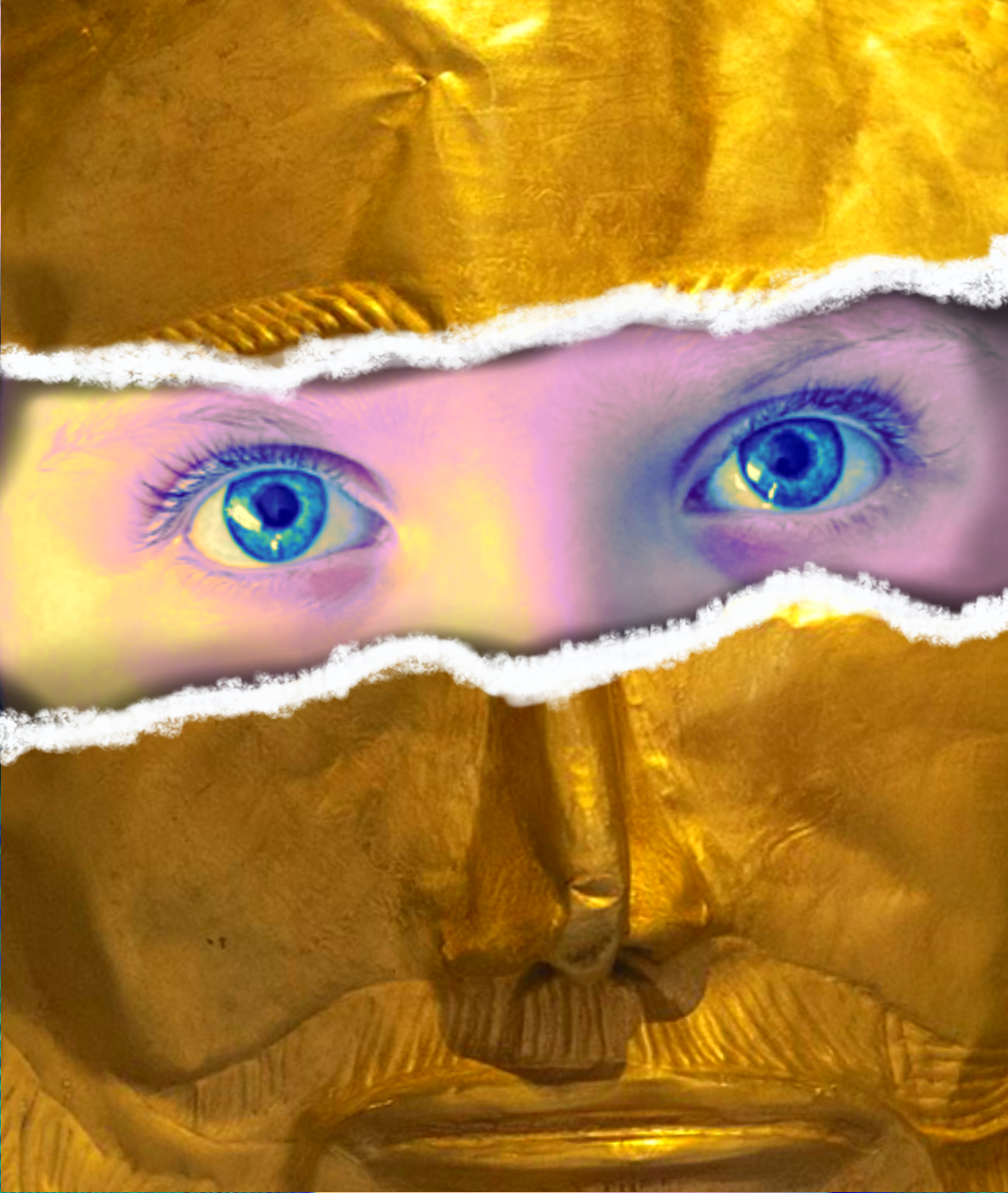
The word costume led me to mask, which led me to persona. In Latin, persona means “mask,” the kind worn by actors in ancient plays. It’s also where we get the word person, and by extension, personality. The entire language of self begins in concealment. The first person was, literally, the one who wore a face for others.
Our most intimate sense of being arrives to us by way of performance.
But the ancient mask wasn’t meant to deceive. It was meant to clarify and to project. Its shape and mouthpiece clarified the character’s emotions and amplified the actor’s voice so the audience could see and hear. The mask didn’t hide the self; it made the self audible.
Sometimes I wonder if that’s what I’m doing when I speak for my daughter. Am I amplifying her voice, or speaking over it?
Her communication is minimal and bodily. Things like a blink, a tension in her jaw, the faintest smile that might mean delight or discomfort. I’ve become fluent in these signals, though my translations are always imperfect. When people meet her, they look to me to narrate what she’s feeling. I supply her lines. “She’s happy to see you,” I say. “She loves the lights.”
Do I give her voice, or do I put words in her mouth?
And what happens when a world built on voices can’t hear someone who doesn’t perform one?
I think about this when I meet new nurses, providers, or parents. I notice how their faces shift in the first moments of encounter. How they reach for a script, any script, that might make the silence less frightening. I do it too. I smile in a way I hope looks competent. Not overly cheerful, not pitying, just steady enough to reassure. It works. The interaction smooths. The performance continues.
But later, I sometimes wonder if I was performing for them, or myself.
We all wear masks. Some are heavy with habit. The smile that says we’re managing, the tone that signals we’ve accepted this. Some we put on to protect others from the rawness beneath. Others we inherit, like family heirlooms of composure.
Yet in caregiving, the mask becomes complicated. It’s not only about what we show or hide, but about what allows us to function. I’ve learned that too much unfiltered fear or sorrow can paralyze the routines that keep my daughter safe. Making ‘choosing joy’ the single load-bearing beam of my life can lead to repeated collapse. I can’t stay in awe or despair for long; there are meds to draw and alarms to check. So I perform calmness until it becomes real enough to act from. Maybe that’s what ritual is for, not to fake a feeling, but to make room for it.
There’s a philosopher1 who once described social life as theater where we’re always managing impressions, playing roles. He didn’t mean we’re liars. He meant that the stage is how we meet each other at all. Every face-to-face encounter is, in some sense, a mask-to-mask exchange.
Still, I can’t help feeling uneasy. I want my daughter to be seen as a person, not a performance. Yet the very word person insists that to be seen, we must wear something. A covering. A voice-shape. A presence that can be perceived.
What does that mean for someone whose presence is already so fragile, so easily misread?
Sometimes, in her silence, I see something closer to truth than my explanations ever reach. Her stillness isn’t absence. But because our language is built on performance, on sound, gesture, and expression, we call her way of being hidden. Maybe she isn’t hidden at all. Maybe we’re the ones behind the masks, too busy performing personhood to notice how much of it is invention.
When I think of persona again, I return to the mask as amplifier. The idea that what we wear for others might not only conceal but make audible. The father-mask I wear, steady, resilient, capable, has carried me through nights I couldn’t have survived bare-faced. Maybe it’s not inauthentic. Maybe it’s just one of the ways I speak.
But there’s danger in over-identifying with it. When the mask fuses with the skin, it can be hard to know where the voice ends. I’ve caught myself talking about oxygen saturations and seizures with an almost professional fluency, as if language could insulate me from the tenderness beneath. As if vocabulary were armor.
I think that a paradox particular to this kind of care is to love someone so wholly that you must sometimes perform yourself into being strong enough to keep loving.
What frightens me is how easy it is to forget I’m performing at all.
The word persona carries within it both the mask and the sound that passes through. Maybe that’s all we ever are: what passes through. Not the mask, not even the face behind it, but the trembling voice between the two.
Sometimes, late at night, I hear her breathing in the dark. The concentrator chugs, the monitor lights pulse faintly, her small exhale catching against the rhythm. I listen. There is no script for this part. No costume, no cue. Just the sound that keeps returning, steady and unresolved.
Just like me, steady but unresolved, just passing through.
Until next time, stay safe, stay kind, and know that you are appreciated.
Cheers,
[kartoffelvater]
Did this newsletter resonate with you? Let me your thoughts or share your own story. And if you know someone who might need these words today, please forward this along.
We wouldn’t be here without you. Every bit of support helps and we appreciate it more than words can say! If you saw my face you would…
Erving Goffman, The Presentation of Self in Everyday Life (Garden City, NY: Doubleday, 1959). Goffman was actually a sociologist (mea culpa, but aren’t we all philosophers in some way?) who developed what he called “dramaturgical analysis,” the idea that we perform different versions of ourselves depending on our audience and setting. He distinguished between “front stage” behavior, where we manage how others perceive us, and “backstage,” where we prepare or drop the performance. His work wasn’t about fakeness but about how the performance itself is the medium through which we meet each other at all.
 Our Little Kartoffel
Leave a comment