Living on the Fault Line of Love and Logistics
Thank you for coming back, or for finding your way here for the first time. However you arrived—I’m so glad you’re here.
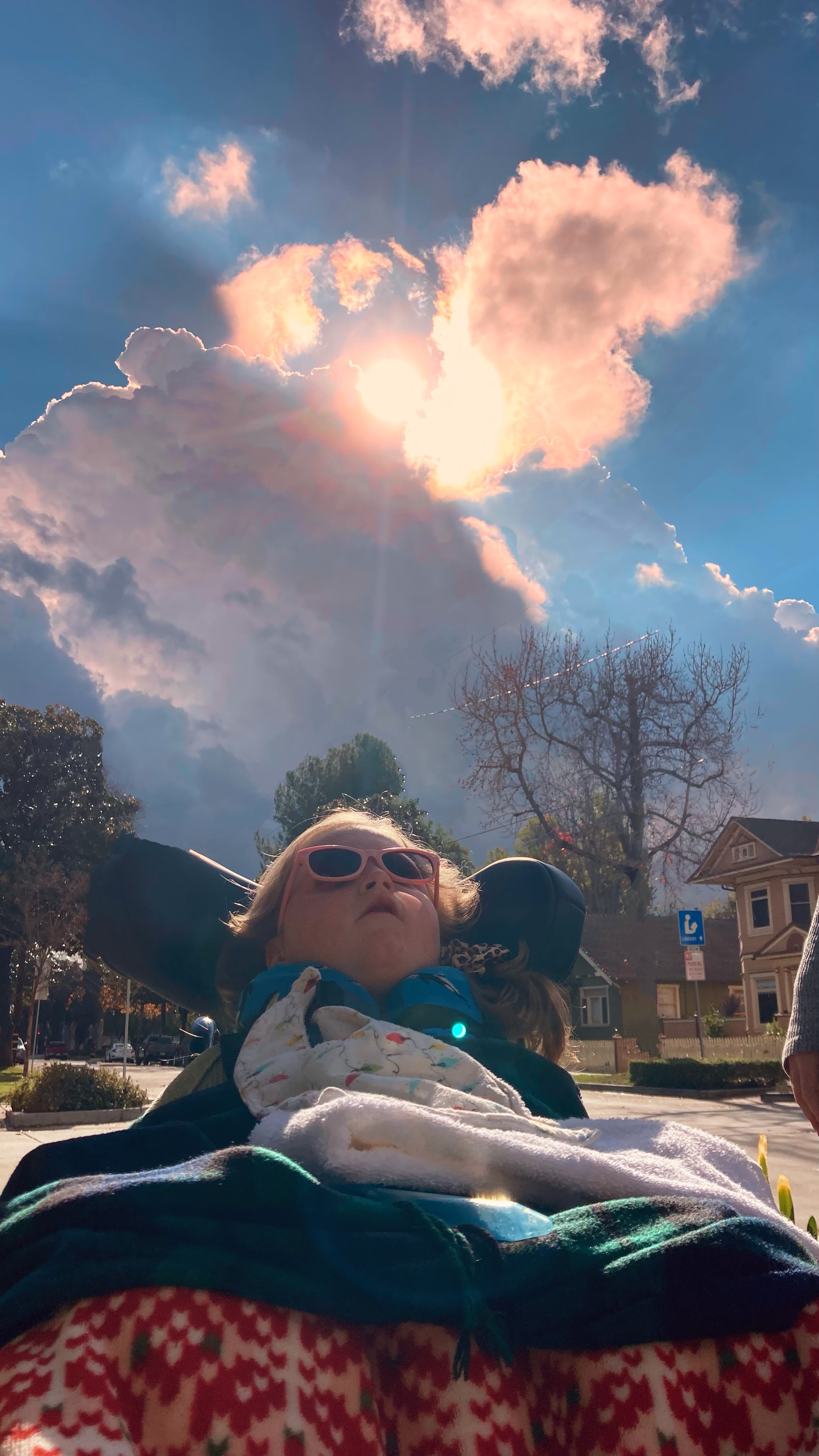
Hallo Kartoffelkumpel,
I had a few thoughts I’d like to share before the end of the year but they aren’t quite ready yet. So today I’m sending out a piece that was originally published over at The Courageous Parents Network. It explores the universal human tension between the subjective experience of living in the moment, called “Here,” and the objective world of data and measurement, called “Nowhere”. This tension is profoundly intensified for parents of medically complex children and so in a roundabout it discusses pediatric palliative care (PPC). Unfortunately, most parents aren’t aware of or misunderstand PPC and so don’t benefit from having them on service. It doesn’t help that when you do get on service and tell people there’s a moment where their response catches in their throat, as if they aren’t sure to be congratulatory or consolatory (I call this the Palliative Pause™) and so you are left wondering if you’ve made the right choice for your child. While by no means an expert on PPC it is something we’ve experienced, and so if you have questions I would be happy to answer as best I can. It was a fantastic service for us that I wish we had fully utilized sooner.
And now, on with the show…
Each morning begins in the small sensations
Small things that remind us we are alive. The bubble of the kettle. The smell of coffee. The way light catches the rim of the mug, making even the ordinary seem briefly radiant. These are moments that belong wholly to the inside of our experience. We feel them before we ever name them. The warmth against our palms, the hum of a refrigerator, a child’s distant cough in another room. All of it arises in sensation before thought can measure or assign meaning.
And yet, we are never only inside. Coffee is a compound of molecules; that light is a frequency; that coughing can be plotted as sound waves measured in decibels. We live, always, in this doubleness, moving between the world as it feels and the world as it is recorded. We live in a body that aches, stumbles, delights and then we invent the abstractions that allow us to make sense of what the ache or the joy might mean. Between these two is the tension of knowing we can never live entirely in either space. We are tethered to changing sensation just as we are ever compelled to find static language for our senses.
Perhaps this oscillation between immersion and distance, heartbeat and calculation is what makes us human: we are the creatures who measure what we feel and feel what we measure.
It is in moments of extremity where we find that measuring either side becomes difficult.
Exploring this tension, philosopher Thomas Nagel once wrote about what he called the view from Nowhere. It’s an impossible vantage point where one sees the world stripped of all subjectivity, rendered in pure, detached clarity. From such a height, emotion and circumstance fall away; all that remains are facts, patterns, causes. Against this, there stands the view from Here with its thick, gauzy embodied immediacy of our personal lives, from which every sound, texture, and heartbeat is felt before it’s understood. The view from nowhere seeks precision and coherence. The view from somewhere clings to meaning, to what it feels like to be a person in a body, loving another person in theirs.
Both views are real, but they speak different dialects. We spend our lives crossing the invisible bridge between these two, wanting to know what’s true, yet unable to let go of what’s ours.
For parents of medically complex children, this tension becomes more than philosophical. It almost becomes the air we breathe. What’s more, we can never rest fully in either. The Here demands tenderness and attention, the kind that can feel the weight of her trust as she melts into your arms. This is the precious ground that friends, family, and fleeting visitors get to stand on. Holding a hand or singing a song, with love unburdened by the brutal calculus of a medication schedule or the terrifying consequence of waiting too long into a seizure to give oxygen. Then there is the Nowhere, which pulls just as hard, insisting only on the cold, unblinking precision of milligrams, milliliters, and flow rates. This is the domain of the provider, where the body is viewed through the necessary lens of protocol and data. Both places, populated by both peoples, are necessary.
To parent a medically fragile child though is to live on the fault line between love and logistics, between the memorable and the measurable. We are forever translating, reading the body as data and the data as life. Always feeling so burdened to find answers in order to make the right decisions.
It is exhausting.
Each step further into the dark brightness of medical parenting feels like an ascent up the mountain into the cloud of unknowing. A climb into thinner air where what once seemed solid begins to shimmer and blur. The higher we go, the ground of the everyday where we once believed love and reason could coexist without fracture begins to erode, and more distance stretches between the Here and the Nowhere.
This widening itself isn’t a problem. All parents, in one form or another, live within the tension between presence and abstraction. We watch our children play, delight in their laughter, then measure their growth on a chart and calculate hours of sleep or minutes of screen time. With enough community, family, and practical support, this balance holds. But for parents of disabled, medically complex, or fragile children, the gap widens until the span feels unbridgeable. Sustaining both perspectives can stretch even the most resilient heart past what ordinary networks can hold. The oscillation that once felt like breathing begins to feel like gasping.
When the ground between Here and Nowhere begins to quake, what parents need most is not to choose a side but to find a companion who can walk the fault line with them. And for parents like us we have guides like Pediatric Palliative Care.
Unfortunately, many of those who could benefit from palliative care enter into it too late, often because palliative care is often misunderstood. However, its most powerful role begins at the moment of diagnosis and especially whenever the medical complexity starts to cause significant family strain, regardless of prognosis.
Its work is not to collapse the Here and Nowhere, but to reveal their interdependence and to steady the traveler caught between them. It does not dissolve medical demands—the Nowhere remains—but what it does is gently make room for the Here.
Neither the Here nor the Nowhere is sufficient alone. The child’s life insists on both. And yet this tension is also strangely clarifying, as though the tension itself sharpens what love means.
If you find yourself constantly translating data and gasping for breath, remember that seeking palliative care is not a failure but an act of self-preservation that will help medical precision to become a form of care, and tender presence to become a form of healing.
It is love learning to breathe again.
Until next time, stay safe, stay kind, and know that you are appreciated.
Cheers,
[kartoffelvater]
Did this newsletter resonate with you? Let me your thoughts or share your own story. And if you know someone who might need these words today, please forward this along.
We wouldn’t be here without you. Every bit of support helps and we appreciate it more than words can say!
I hope you enjoyed this post. Don’t forget to check out the original article over at The Courageous Parents Network, a fantastic resource for exploring the world of raising children with disabilities and rare genetic disorders. Be sure to visit their site for more insights!
 Our Little Kartoffel
Leave a comment