And what I hope to take with me when we leave.
Thank you for coming back, or for finding your way here for the first time. However you arrived—I’m so glad you’re here.
Hallo Kartoffelkumpel,
This is a longer piece than usual. It was written at our daughter’s bedside during our recent stay in the Pediatric Intensive Care Unit (or PICU, as you will see throughout). It also happened to be Advent while we were inpatient, and the essay unfolds slowly, much like the season. If you need to step away and come back, it will still be here. Let it take the time it takes.
I was already tired.
The emergency room generates a particular frequency that leaves a buzzing in your ears. My nervous system had been on high alert for so long even standing felt like a decision. Weary before anything had even been said out loud.
I arrived at the satellite unit at 7:06am. I don’t remember looking at the time but when writing this I looked back at the ‘Just parked.’ text I sent my wife. I drove separately because the med transport from the overwhelmed main hospital only had room for one parent.
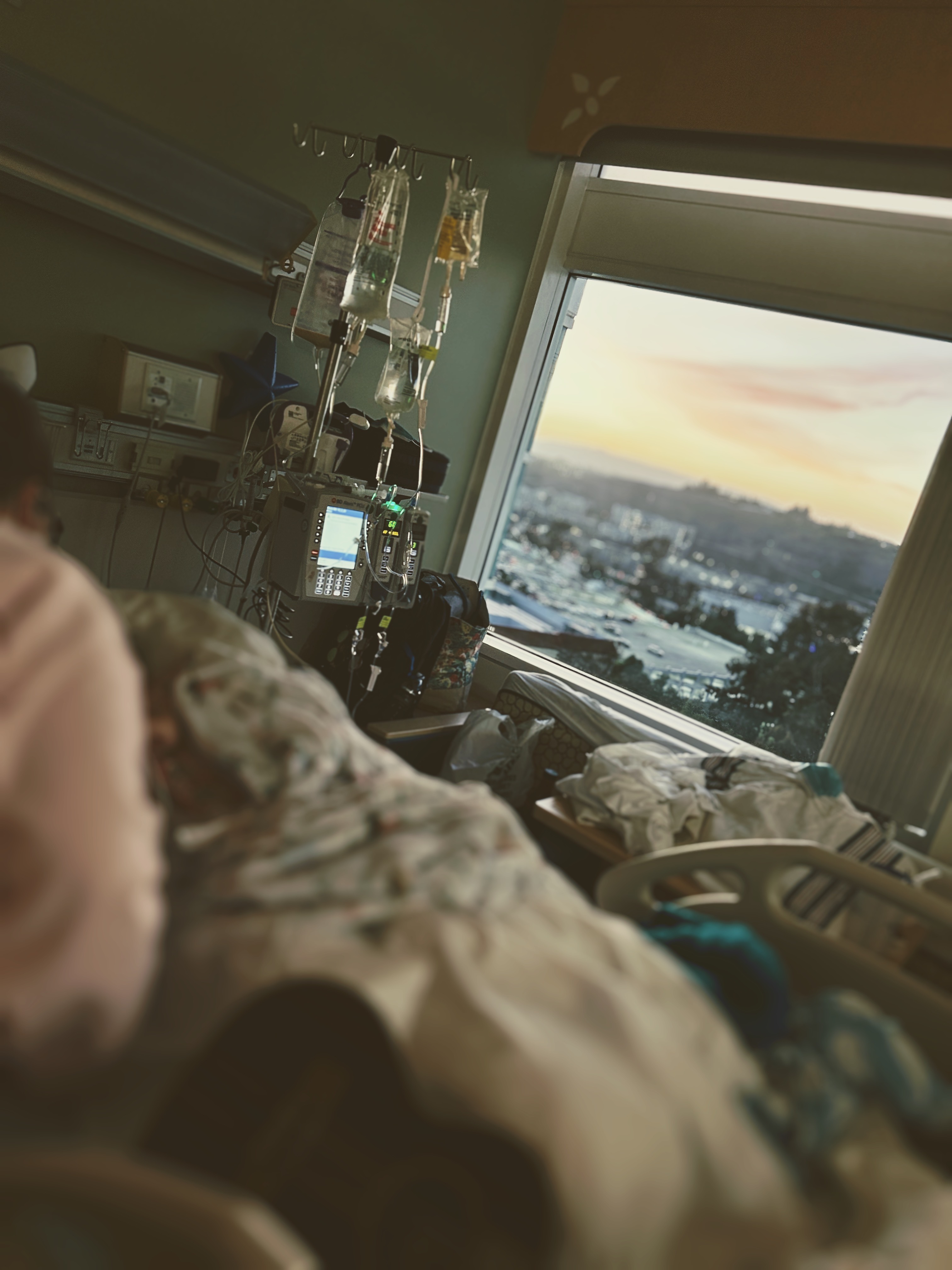
The air in the PICU was thick, as if I had walked into one of the Kartoffel’s lungs, currently full of aspirated pedialyte and mucus. There was that familiar smell, though. Something citrusy, lemon zest maybe? Whatever scent the cleaning companies infuse their products with to reassure you that sterility doesn’t have to smell like alcohol.
The floor gleamed in a way that made every movement feel amplified. Shoes squeaked as nurses moved quickly but carefully across it, rushing to aid at some child’s bedside. Somewhere nearby, a plastic packet crinkled open and released syringes, tubing, gauze. All ordinary sounds here, but loud enough to register. The monitors murmured in their steady synthetic cadence. But really what I noticed was the odd calm in this controlled chaos. Not silence, exactly. More like a hush that had been negotiated.
Parents sat close to bedsides, bodies angled inward, conserving energy. I assume their expression of trying not to unravel was the same one I had on my face. All of us with our grief being held in check by posture alone.
Everyone waiting. No one resting.
In worlds outside the hospital, people were moving through a season of darkness and anticipation. Lighting candles, counting down, telling children about a waiting that ends in good news. Inside the PICU, we were waiting too, but without the assurance of how the story would resolve. The irony wasn’t lost on me. Advent asks you to believe that something is coming. The PICU asks you to sit with the possibility that it might not.
What follows are thoughts I had at her bedside, forged slowly in the space between beeps and breaths. They borrow language often reserved for church conversations—faith, hope, love—but not because those ideas belong to religion alone. I think they belong to anyone who has had to live where certainty runs out. Anyone who has needed a way to remain human inside a system that measures life in decidedly inhuman ways.
The PICU has a way of stripping sentimentality from words. It forces them to earn their place. Faith, hope, and love survive here only if they are sturdy enough to bear weight. Only if they can function as more than decorations.
This is an attempt to articulate what held me together as I was falling apart this past week.
Faith: The Performative Substance
I always feel like I’m borrowing someone else’s hands and I forgot to ask what I’m allowed to do with them. Can I put them in my pockets? Fold my arms and hide them? So I just end up endlessly rubbing them together, the tactile feedback reminding me this nightmare isn’t one I will wake up from. And after having failed knowing what to do with my hands, next is knowing where to stand. Literally and metaphorically.
The PICU teaches you very quickly that having information is not the same thing as having ground to stand on.
The room is saturated with knowledge. Numbers scroll. Waveforms rise and fall. Alarms announce changes before your body has time to register them. Saturations, pressures, rates, volumes. Each one a small window into what is happening inside this tiny body we love. And yet, none of it tells me where to stand.
I used to think faith was a kind of private belief, something held quietly, internally, my own conclusion about the unseen. But at the bedside, belief in that sense feels flimsy. Almost decorative. Information is abundant here, but certainty is not. The data keeps coming, and still the question remains: What do you do with your body? Where do you place your weight?
Faith, as I have come to understand it, is not primarily about what you think. It is about what you do when thinking runs out.
Every day in the PICU involves a series of small, irreversible acts. You nod as plans are explained. You sign your name. You step back while hands you do not know well enough reach toward the person you love most. None of this is driven by confidence in a particular outcome. It is driven by something more basic and more exposed: the decision to trust, and to act on that trust.
This kind of faith is performative in the actual sense; it manifests in the performing of actions. It does not describe the world; it enters it, performs in it. It is the act of standing on ground you cannot see and discovering, only afterward, that it holds.
There is a strange reversal that happens here. Outside the hospital, we tend to imagine faith as something that helps us make sense of the future. Inside the PICU, faith pulls the future into the present. It shows up not as assurance about what will happen, but as the willingness to participate in what is happening, even when the words for the story you wanted to write for are no longer available.
It does not require imagining a better ending. It requires accepting that meaning is not postponed until resolution. Faith is the decision to treat the unseen things, the competence of the team, the care embedded in routines, the shared seriousness of everyone in the room, as real enough to act upon.
When the floor is removed, faith becomes whatever allows you to stand without pretending it hasn’t. Faith is what we stand on—not because it explains the room, but because it allows us to inhabit it.
Most days it feels more like compliance than conviction. But slowly, you realize that this, too, is a kind of knowledge. A knowledge that lives in the body. A knowledge that says, I do not know how this ends, but I know I will remain.
Hope: The Coordinates of Reality
If faith answers the question of what we stand on, hope answers a different, more destabilizing one: Where are we, really?
Modern medicine is built on a particular story about time. It assumes a forward arc, a sequence of problems moving steadily toward resolution. Progress is its governing metaphor. Each machine beeps with that promise. The implication is subtle but persistent: suffering is a technical error. It’s something that appears when a system hasn’t yet been perfected. Given enough data, enough refinement, enough innovation, it should eventually disappear.
This belief has consequences.
When suffering is framed only as a malfunction, the present becomes something to endure rather than inhabit. Life is placed on hold, suspended until the fix arrives. Hope, in this framework, is reduced to optimism with the quiet conviction that tomorrow’s technology will succeed where today’s has not. We wait. We endure. We count the days by what has not yet happened. But the relentless now of the PICU is organized around urgency, not patience.
True hope cannot survive in us as a wish for escape. It has to do something more difficult. It has to teach us how to live here.
There is a deeper hope that emerges when progress fails to deliver its promised rescue. Not the hope that things will improve, but the hope that this unbearable, ordinary, singular moment is not meaningless simply because it is painful. This is the hope that refuses to outsource significance to the future.
For me, this hope is not abstract. It is located with precision.
It has a who: my daughter, as she is, not as she might become.
A where: this room, this chair, this bedside.
A when: this breath, then the next.
Hope, understood this way, is not a feeling that rises without intention. It is a posture you take. An orientation you commit to. It asks you to move toward reality rather than away from it, even when reality offers no reassurance.
This kind of hope is active and difficult. It demands participation. It requires radical responsibility for the present moment because it is where life actually happens. It insists that being a father to a suffering child is not a placeholder role, something provisional until “real life” resumes. It is real life, asking to be lived with attention and care.
Hope, then, is not the denial of suffering. It is the refusal to let suffering have the final say about what counts.
And it is never solitary.
Hope in the PICU is always communal, whether we want it to be or not. It lives in the shared language of the care team, in the rituals that repeat across shifts, in the agreements made without words. It is carried between parents, nurses, physicians, each of us holding a small piece of the present steady for one another.
This is why hope cannot be reduced to optimism. Optimism isolates; it lives or dies on outcomes. Hope binds. It creates movement even when the destination is unclear. It allows us to act with meaning without waiting for permission from the future.
Hope does not ask whether this suffering will be justified in the end. Against the machine’s promise that suffering is merely a glitch to be corrected, hope makes the more radical claim that to remain engaged, attentive, and faithful in the midst of irreducible pain is not failure, but the measure of our humanity.
True hope is not a passive wish for an outcome, but an active, difficult, and communal commitment to movement, radical responsibility, and principled action in the present moment.
Love: The Engine of Expression
If faith is what we stand on, and hope is how we locate ourselves in time and place, then love is what finally moves. It is the force that gives form to everything else. Not as sentiment, but as specific, costly, and embodied action.
In the PICU, suffering does not merely coexist with love. It refines it.
There is a stripping that happens here, an incineration of what once demanded attention. The things I thought mattered 8 years or 4 weeks or even 2 days ago have not disappeared, exactly, but they have lost their gravity. Career ambitions. Social obligations. The low-grade anxieties that usually organize a day. They drift through my mind like recognizable yet insubstantial ghosts. I can see their outlines, remember their weight, and yet they no longer ask anything of me.
These were what I once called priorities. Now they feel like supernumerary objects of care orbiting a life that has suddenly contracted around something more precise. Life with the Kartoffel, as I heard someone put it, burns away the bullshit.
Love, under this kind of pressure, becomes exacting. It no longer spreads itself thin across abstractions. It does not concern itself with what might matter later, or elsewhere, or to someone else. It fixes its attention here, on this body, in this room, at this hour.
There is nothing abstract about it.
Love is the way my hands finally learn what to do. They rest where they are allowed. They follow the cues of nurses who have done this longer than I have. They offer comfort without demanding response. Love becomes measured in how long I can stay still, how gently I can speak, how fully I can accept what this moment requires without flinching away.
We are often encouraged to love broadly—to love humanity, to love the world, to love ideals large enough to keep us from having to encounter anyone too closely. We are taught not so much the look of love but rather a love of looking. But love shaped by faith and hope refuses that distance. It insists on proximity. It is not polite. It does not generalize. It is a decision to suffer with, rather than to feel for.
This kind of love makes a claim on the world.
To love my daughter here, in this state, is to accept suffering as a fundamental human experience rather than an aberration to be corrected or hidden. It is to insist a life organized around care rather than obsessed with cure is not a lesser life, or a tragic deviation from the norm, but a fully human one.
Love, then, becomes the engine that carries hope outward. It refuses to let hope remain a private stance. We are bound together by bodies, by systems, by shared vulnerability and because of this my hope for her necessarily implicates others. It asks something of the room. Of the routines. Of the people who enter and exit this space with practiced tenderness. Just as the hope of others necessarily implicates me.
In this way, love asks a question that lingers beyond the bedside: whether our world knows how to make room for this kind of devotion. Whether we have a moral imagination capacious enough to recognize attention, endurance, and faithful hope as meaningful work.
The Standing Ground
Taken together, faith, hope, and love are not simply ‘nice things good people do.’ They are ways of standing when the usual supports have been removed. They are habitual and firm dispositions toward the Good and, along with the other virtues, help us complete all the appropriate acts and are the key to living a fulfilling and meaningful life.
Faith gives you something solid enough to place your weight on, even when certainty is unavailable. Hope tells you where you are allowed to live, without postponing meaning until conditions improve. Love moves you into that space with precision, asking your body to participate in what your mind cannot resolve.
None of these fix the PICU. They do not pause the alarms or loosen time’s grip. They do not redeem suffering or make sense of it in retrospect. What they do instead is allow a human life to remain human under conditions that threaten to reduce it to data, diagnosis, or delay.
They make it possible to inhabit the room rather than merely survive it.
Eventually, of course, the room releases you.
At some point, we will leave the PICU. The monitors will fade into memory. The negotiated hush will give way to ordinary noise. Outside the hospital, Advent will have passed. Candles extinguished. Calendars turned. The season of waiting, at least for everyone else, will be over.
But for us, the waiting will not end so neatly.
It will change shape. It always does. It will follow us home, settle into new routines, find quieter ways to ask for attention. And I find myself not for the first time wondering whether the way of standing I learned here can survive outside these walls.
Can faith still be performative when the crisis is no longer visible? Can hope remain anchored to the present when there is more space to drift into distraction or denial? Can love stay as exacting when the bullshit returns and those supernumerary objects of care begin, slowly, to regain their gravity?
I don’t have answers to those questions. I only know that they are still being lived at bedsides like hers.
What I will have instead when we are discharged is a memory of how it felt to stand here, my hands finally knowing what to do, attention narrowed to what mattered, meaning located not in outcomes but in her, in us.
Perhaps that is enough to carry forward.
As a way of returning again and again and again to the ground beneath my feet. A way of remembering that faith, hope, and love are not reserved for certain religions or certain seasons or certain rooms. They are what allow us to remain human when waiting stretches on and the story refuses to resolve.
This is what I hope to take with me when we leave.
Until next time, stay faithful, be hopeful, and know that you are loved.
Cheers,
[kartoffelvater]
Did this newsletter resonate with you? Reply with your thoughts or share your own story. And if you know someone who might need these words today, please forward this along.
We wouldn’t be here without you. Every bit of support helps and we appreciate it more than words can say!
 Our Little Kartoffel
Leave a comment