Between appointments and obligations, happy days and holidays, all held together by our small rituals and the people who have become the ground beneath our feet…February is a month that holds a lot for us. It has a way of reminding us to look closely at the lives we are actually living, not the ones we imagined we would have by now. I hope this shortest month with the longest days finds you holding what you need, and being held by those you need.
I noticed the bottle one afternoon while cleaning out the refrigerator.
Dark glass. A narrow neck. It must have been the kind of bottle you don’t throw away right away because it held something worth remembering. I turned it in my hand and read the label: 2014. That was, by all accounts, a very good year. I remember receiving it now, who we were with, and the unspoken assumption that there would be many more like it.
At the time, I would have told you this was how a life was supposed to work. You laid things down carefully; you let them age, and you trusted that, when the moment came, you would know how to pour. That bottle belonged to a different life, one designed for long evenings and unhurried company, for the clink of glasses meeting midair and the smell of woodsmoke threaded through conversations about the future. All my yesterdays were so full of tomorrows.
And as I stare at the bottle, an unfounded guilt starts to gather.
Not the guilt of having broken something, but of having misused it. As though a life without a medically complex child could be opened fully and savored without interruption. Not necessarily a life without hardship, but hardships born lightly and moved through expediently. Before, I thought that suffering must be done nobly, with a composed voice and steady hands. Could life be measured based on what it actually holds and not just what I wanted it to hold? The bottle was never ruined after all; it just isn’t holding what it once promised to hold. I set it on the counter and kept cleaning.
Standing in front of the open fridge now, the analogy continues to unfold. The bottle is still sound, the glass uncracked. The wine held fast by an undamaged cork. The label remains crisp and legible, displaying, in my mind, so much more than year and vineyard. It is announcing a whole life built of the expectations of that younger version of myself.
Like so many years ago, I again did not throw the bottle away. This time, instead of returning it to the fridge, I rinsed it out, letting the water run until the last traces of the old vintage were gone. I peeled back the label slowly, careful not to rip apart the memories it contained. What remained was simpler than what had been promised.
The bottle, and the life that it represents, is not a failure. It has been repurposed, it is a vase now.
The admission lands with less drama than I may have expected. A vase is a modest thing. It does not hold intoxicating promises. It is meant to stay put, to be stable, to hold without calling attention to its own design. Before, I imagined myself a full bottle, offering something rich and expansive. I have become more like the vase, holding something much simpler yet necessary to keep something precious alive.
The world still demands the mindset of that former self though. It shows up in many areas of my life. My career that rewards the privilege of consistent momentum. The friendships that aren’t as easy to maintain now that I’m always requesting accommodations. The invitations to travel, the asks to show up, to say yes, all while having to calculate what it will cost at home. Conversations still open with What’s next? as though the future were a neutral resource. Even praise for me as a caregiver is spoken in the old grammar, with phrases that call me impressive, productive, or busy.
I’ve come to realize that the ache of who I once imagined I would become doesn’t fade just because I’ve given my role a new name. The world is still calling, regardless of my positive reframing. The sense that a life once forecast with confidence has come in under expectation reverberates even in the smallest moments, like when a friend texts to ask if I can meet for coffee, as though they are reaching for the older version of me. I have spent so much time living as though the person I might have been is here now, waiting for me to explain myself. But how do I explain the weight of her on my chest? The ache from being torn between wanting sleep but not wanting to miss a thing? How do I explain that being home for her bedtime routine is more important than any night out with friends will ever be?
It has been an ongoing challenge for me to shift my understanding of what I want my life to look like now that my days are dictated by the needs of a medically complex child. And though I am no longer full of the vivacious libations I once was, neither am I empty. I now hold what is necessary for those that cannot survive without me. I am a vessel for a life that no longer photographs well, but that quietly persists. I have found mercy in letting my life as a caregiver be what it is without demanding it justify the change.
When I can hold myself with the same steady regard I offer my child, the gap between my real and ideal self finally begins to close. I start to become, at last, a better friend to myself. The kind of friend who can laugh at the clumsiness of the work while holding the water needed to sustain just one, precious thing.
To live as the vase is to stop apologizing for not becoming the person I might have been. It is to acknowledge the uncomfortable certainty that I am the parent I have needed to become, and to understand that this is not a moral failure. The bottle was altered by necessity, not neglect.
Life was altered by love.
Until next time, stay safe, stay kind, and know that you are appreciated.
Cheers, [kartoffelvater]
Did this newsletter resonate with you? Let me your thoughts or share your own story. And if you know someone who might need these words today, please forward this along.
We wouldn’t be here without you. Every bit of support helps, and we appreciate it more than words can say!
I hope you enjoyed this post. Don’t forget to check out the original article over at The Courageous Parents Network, a fantastic resource for exploring the world of raising children with disabilities and rare genetic disorders. Be sure to visit their site for more insights!
Thank you for coming back, or for finding your way here for the first time. However you arrived—I’m so glad you’re here.
For the uninitiated the last day of February is set aside to honor people living with and alongside rare diseases. There are hashtags, purple ribbons, awareness campaigns, carefully chosen stock photos of smiling children in wheelchairs, copy text about resilience. The grammar of awareness is familiar by now. It asks us to notice, to learn, to care.
But as I sat down to write about just how rare she is, something else came to mind.
She isn’t rare at all; she is the opposite. She is ubiquitous. She is the single most present thing in my life. We are two folds in the same tablecloth at the banquet of life, tugging and smoothing the same fabric, spilling on the same places, living inside the same stains.
Rarity is a statistical category. It lives in spreadsheets, in prevalence rates, in the language of funding cycles and research pipelines. It belongs to the way medicine sorts and prioritizes bodies, the way institutions decide which lives get legible, which conditions get named, which suffering gets indexed. All of that matters. It shapes who gets help and when. It determines which clinics exist, which specialists you can see without driving three hours and taking a day off work, which questions can be asked because there’s a billing code to hold them.
But none of that is how she exists to me.
To me she is the sound of her breath at 2:13 a.m., the way the house goes still when a machine alarm cuts through a dream. She is the weight on my chest when her body is cold and needs to borrow my warmth for a while. She is the particular way her laugh breaks open a room that is otherwise heavy with unspoken fear. She is the choreography of tubes and medications and the small, fierce rituals of care that bracket our mornings and nights.
This isn’t to say there aren’t rare aspects of her. There are several: a certain genetic mutation; her wondrous talent for making conversation without making it entirely about her trauma; her complete inability to live de mauvaise foi; her penchant for bringing people together; her friends and family who have been willing to grow with us and learn how her life rigidly demands flexibility.
Her rarity shows up in exam rooms when clinicians lean in a little closer to the chart, when we become case studies by accident, when we are thanked for our “patience” because there is no protocol for this constellation of needs. It shows up in the way things like insurance systems, school districts, transportation requirements all assume a default body and then quietly fail anyone who doesn’t fit inside that template. Her rarity shows up in the assessment forms with boxes too small to hold the truth, in the phone trees that loop endlessly when you try to explain that your child’s needs don’t align with the options on offer.
It has been tempting these past six years to view her rare diagnosis as an obstacle. As an intrusive “something over there,” while who she really is lives “over here.” To tell ourselves that if we could just cure it, get around it, un-dam the damn thing, then maybe the rivers of our life would finally flow. As if there is a normal life stalled somewhere upstream, waiting for us to clear the blockage so it can arrive on time and according to plan.
Meanwhile many of the things we hoped for have not come to be, and many of the things we dread are now here.
This is the futility of a hope that is only oriented toward the life we were promised rather than the life we are living. This kind of hope can become a way of postponing presence. A way of loving some imagined future version of your child more than the child who is breathing in front of you right now. It can turn care into a holding pattern with mantras such as we’ll really begin once this diagnosis loosens its grip; we’ll really live once the system stops being so disorienting; we’ll really rest once the crisis phase is over.
But the crisis phase is no longer just a phase.
Her diagnosis isn’t something that happens to her. It’s just one way of trying to understand one facet of her existence. It is the language that medicine uses to speak about her body. It is not the language she uses to speak about herself. And when I confuse those two, I start relating to an abstraction instead of a person.
Parsing out her biological rarity, then, is a comparison game; and I have no great interest in doing that. Rare, compared to what? Compared to whose body, whose baseline, whose imagined normal? Comparison is the thief of connection. It tempts me to measure her life against a statistical average and call the difference a catastrophe, rather than to meet the singularity of her being and call it a relationship.
Letting her diagnosis be just one part inside the imponderable bloom that is the Kartoffel allows for all that splendid ambivalence around holidays, milestones, and awareness days. It lets me hold gratitude and grief in the same hand without asking either of them to justify being here. It lets me show up to Rare Disease Day without needing to perform inspiration or despair, without seeking absolution for experiencing conflicting (or unpopular) thoughts and emotions.
There are days when awareness campaigns feel like a thin layer of paint over a cracked wall. On those days I want to ask what awareness does when it doesn’t come with structural change such as respite care, or accessible housing, or reliable home nursing, or schools that don’t require parents to become full-time case managers just to secure basic accommodations. There are days when “honoring” feels like a euphemism for noticing without altering the conditions that make life so hard.
And there are days when I’m grateful for the simple fact of being seen, however imperfectly. For the provider who says, “I don’t know, but I’m willing to learn.” For the stranger who doesn’t look away when my daughter’s body draws attention in public. For the small mercies of community that appear in waiting rooms and online forums, in late-night messages between parents who recognize each other’s exhaustion.
Her diagnosis is rare, and yet her Being-in-the-world has become the absolute foundation of my facticity. This is the ground of my life now. The systems I move through, the language I use, and the questions I ask – about what counts as care, about whose bodies are considered costly, about how grief and wonder can coexist in the same afternoon – have all been rewritten by the daily labor of loving her.
As we honor Rare Disease Day, I hope a growing community takes time to reflect on the ways our culture struggles to make room for bodies that don’t conform to its narrow expectations of productivity, independence, and ease. My deepest hope is that we change the way we treat care as a private burden rather than a shared practice; because the truth is, people living with medical complexity are not edge cases. Rare diseases exist amongst our neighbors, our classmates, our colleagues, our family, and our friends.
She is rare, precisely because she isn’t.
She is everywhere in my life: in the way I think about time now as something elastic, punctuated by alarms and appointments and the long, slow work of waiting; in the way I understand dignity as something that has nothing to do with efficiency or self-sufficiency and everything to do with being met where you are; in the way I imagine a good society as one that is built for the most vulnerable first, becoming gentler for everyone else.
On Rare Disease Day, I can hold the colored ribbons and the spreadsheet in one hand, and her warm, inconvenient, luminous presence in the other. I can honor the language of rarity without mistaking it for the truth of who she is. And I can say, with as much steadiness as I can manage: she belongs without qualifiers. Rarity is a framework for medicine and advocacy, not a measure of worth.
She is life, up close.
Until next time, stay safe, stay kind, and know that you are appreciated.
Cheers, [kartoffelvater]
Did this newsletter resonate with you? Let me your thoughts or share your own story. And if you know someone who might need these words today, please forward this along.
We wouldn’t be here without you. Every bit of support helps, and we appreciate it more than words can say!
I hope you enjoyed this post. Don’t forget to check out The Courageous Parents Network, a fantastic resource for exploring the world of raising children with disabilities and rare genetic disorders. Be sure to visit their site for more insights!
It’s that time of year when the world gets very loud about a certain kind of love. The kind that comes wrapped in cellophane and tied with a perfect bow. It’s hard to ignore the sudden rush toward the bright and the polished. Things have been heavy and beautiful in equal measure lately, as they often are in our corner of the world, so it’s got me thinking about those of us whose devotion doesn’t fit on a greeting card. Those whose love is measured in milligrams, nightly vigils, and an endless calendar of choosing to be present. Before we get into it, I just wanted to check in and remind you that the “less than radiant” work you’re doing is the realest thing there is.
Love is the most dangerous and transformative act a human can commit.
Not the flashy kind you see in movies, but the real stuff, the kind that shakes you up and keeps you going when the days get long. The kind that doesn’t come with a bow on it, the kind we live every day with our children who don’t fit the world’s tidy little boxes. I’m thinking of the Kartoffel, her rare self, a constellation of quirks and seizures, and how loving her isn’t some oil painting you’d frame on the wall. It’s an obscured, muddy, fierce thing, rooted deep in the marrow of us parents and caregivers who know the drill of meds, waits, and the nights that stretch too long. This love doesn’t ask for an “I see you.” from others. It just is as it is. Solid as the earth, wild as a storm, and bigger than the whole sky.
We become practical souls, don’t we? We chart the hours, measure the doses, build small routines to keep the chaos from spilling over the lip of the day. You don’t always get to map out this path; but you can find who you are inside it, staying long after you might have chosen to leave. You stay without conviction, often without clarity, because leaving would cost more than you can afford.
In this narrow space, your attention undergoes a revolution. You stop chasing the shadows of who she might have been or tallying the milestones she won’t hit. Instead, you learn the discipline of the gaze—looking at who is actually in front of you, even when the picture refuses to come into focus. It is a steady, rhythmic “Here you are.” This isn’t a love that fixes or fills gaps; it is a love that makes enough room to breathe. Sometimes the breath is shallow, sometimes it’s borrowed, but through your fidelity, you realize you are no longer bracing for a change. You are simply remaining, attending to the human that just won’t let you go.
Mind you, it’s a reckoning too. Loving like this breaks you open, strips away the bits that crave a nod or a “well done.” You don’t ask, “What’s my reward?” because the question falls flat in the face of it. Let that go, and you’re not boxed in anymore, you’re spilling out, woven into them, part of a bigger dance. It’s an agony, sure, but a beautiful one. Our children feel it too, unshackled from the roles we might pin on them. They’re not here to prove anything, not to us or the world. We see them in their stumbles, their sparks and spasms and say,
“I’m here. You’re enough.”
This love doesn’t lift us out of it, does it? It takes the slog—the diapers, the chairs, the endless rounds with doctors—and refuses to let it become empty. I think of us, cradling tiny humans who might never toss a ball or whisper “thanks,” and the world shrugs, calls it a pity. But we know how little that word used that way explains. Stripped of the usual trappings, this bond binds us without promising that either of us will become more than we already are. A hand on a cheek, a shared silence, what remains when there’s nothing left to say.
This less than radiant but relentless love stays close to where the shadows pool. You stay when the seizures hit, when the news cuts, when you’re so weary you’d trade your soul for sleep. You’re close, unsteadily saying, “I’m here.” It’s raw, unglamorous, and it holds. Through the muck and the ache, it’s the thread that keeps our tapestry from falling apart.
So, what does it build, this love (is build even the right word)? Space. Not for us to mend, but space for the mending to take place should it arrive. It ties us to each other with a knot we must choose to keep retightening, hoping to outlast the days that would unravel us. In a life that can feel like a storm with no end, it plants meaning where the ground’s gone soft. And here’s the gift: it frees us all. They get to be, just as they are, even when others would keep the strings attached. We learn to carry the weight without feeling the guilt of not being enough. We love, and that’s the whole of it.
But this isn’t a solitary vigil. If you look closely at the architecture of this life, you’ll see the same light burning in windows across every zip code. We may be a ragtag crew of carers, but we are a community. Not because we share the same struggles, or the same diagnoses, or treatments, or anything else outside of us. We are a true community when we have agreed to love the same difficult, beautiful things.
We are bound together by what we have chosen to hold dear in the dark.
If we acknowledged that, and really saw the collective strength in our unsteadiness, the hard days wouldn’t vanish, but they’d carry a weight worth bearing. It would be a ripple that starts in the puddles of our own backyards and ends by shifting the world’s axis just a hair.
It’s not easy, I know. Takes everything you’ve got some days to live fuller, to hold closer, to brush against something bigger than the daily grind. It sees us peeling back the layers, starting fresh when we’re anything but, stretching past ourselves into the wild unknown.
So, do we keep at it? Let it shape us, our families, this life we’ve got?
Damn right we do. It’s a love that is ours to claim.
Always has been.
Until next time, stay safe, stay kind, and know that you are appreciated.
Cheers, [kartoffelvater]
Did this newsletter resonate with you? Reply with your thoughts or share your own story. And if you know someone who might need these words today, please forward this along.
We wouldn’t be here without you. Every bit of support helps and we appreciate it more than words can say!
Feeling the cost of survival in the quiet of home.
Thank you for coming back, or for finding your way here for the first time. However you arrived—I’m so glad you’re here.
Hallo Kartoffelkumpel,
There is a specific kind of exhaustion that only shows up once you’ve finally sat down. It’s a tired that waits until the room is quiet to remind you how heavy your own limbs have become. Lately, I’ve been thinking about how we carry ourselves through the days we never thought we’d have to survive, and what happens to that momentum when the immediate need for it vanishes. It’s a strange thing to realize that sometimes the hardest part isn’t the climb itself, but the way your body shakes once you’ve reached the plateau. I’m checking in on all of you navigating these heavy after-moments (and if I haven’t checked in on you and you would like me to, let me know).
It took a few days.
We came in from the cold, yes. We slept in our own house. We made coffee in our own kitchen. But those first days after discharge from the PICU felt more like a relocation than a return. I didn’t really feel I could say we were home yet. For days our bodies still pitched forward, waiting for the next interruption. Adrenaline doesn’t care about addresses. It lingers. It keeps its own calendar. Makes your fingers restless.1
It was later, a handful of nights in, when stillness finally found me.
The living room was dark except for the Christmas lights we had draped along the footboard of her new hospital bed. We’d just had it delivered. It was an abrupt, practical upgrade that arrived with the authority of necessity. It made caring for her easier. It also rearranged the room around a truth we could no longer pretend was temporary.
We slept there together for a while. My daughter in the bed. My wife and I trading the couch and the recliner. The house held us, but tentatively, like it wasn’t sure yet what version of us had returned.
My daughter slept (or really more rested, or maybe hovered?) in that ambiguous space we now call stable, though I’m no longer certain what that word means outside the hospital. Exhausted, but holding. Alive in a way that feels provisional only because everything does now.
The absence was loud.
We still had the machines that breathe with her, the monitors that translate her body into numbers. But now there were no nurses passing by with practiced glances, no quiet reassurances spoken fluently in acronyms. Just us. Just the dark. Just the soft, uneven sounds of a house settling around a child who has never really fit inside ordinary definitions of safety.
I realized then that what I missed was not the crisis, but the company.
In the PICU, vigilance was shared. At home, it became solitary again. Just us. There was no one to hand the watch to. No one to confirm that what I was hearing—or not hearing—was acceptable. Every sound felt suspicious. Every silence required interpretation.
I watched her chest rise and fall in rhythm with the vent, the Christmas lights reflecting faintly off the metal rails of the bed. The cup of water on the coffee table caught my eye. The glass looked too thin. Too breakable. The same feeling I’d had in the hospital, now relocated, domesticated.
My hands were still shaking. There was nothing left to hold.
During the crisis, everything had been sharp. Time narrowed. Attention hardened. My body knew exactly what to do because it had no other choice. Stand here. Listen harder. Stay ready. Urgency edited the world down to its essentials.
Home removed the editor.
Stillness arrived without instructions. The danger had receded, but it hadn’t left. In the PICU she is under a microscope, but here it felt more like I was looking at her through the wrong end of a telescope. The house was quiet in a way the hospital never was. Not a negotiated hush, but an ordinary one, the kind of quiet you might imagine as you hum along to O, Holy Night. The hush people usually associate with peace and poems.
High alert had ended, vigilance hadn’t. My body didn’t know how to downshift. It kept scanning, listening for alarms that didn’t exist, replaying moments that hadn’t gone wrong just to be sure. And then there is that awful aching.
It didn’t begin all at once or dramatically. It settled in like dampness. My jaw hurt from days of clenching. My shoulders sagged as if something heavy had been removed without warning. Even standing at the sink felt like effort. Ugh, the damn sink.
The sink was full of mugs. Laundry sat unfolded on the couch. In the hospital, coffee comes in paper cups you throw away. You wear the same clothes for days. The world is pared down to what matters most, and everything else politely disappears. At home, it all returns at once. Dishes. Clothing. Trash needing to be taken out. Dust needing to be swept. The small maintenance rituals of a life that assumes continuity.
I stood there longer than necessary, staring at the mugs, unsettled by how uncannily fragile this version of normal felt. As if I was washing with someone else’s hands and the act itself might ask more of me than I had left to give.
We talk a lot about resilience as endurance. About holding fast, pushing through, staying upright no matter the cost because we don’t have any other choice, because you would do it too if you were in my shoes. That story makes sense when everything is actively falling apart. Endurance explains how you survive the moment when the stakes are unmistakable.
It explains far less about what comes after.
Stillness exposes a different kind of fragility. Without urgency to organize you, the cost becomes visible. You are left alone with the residue of attention. With the knowledge of how narrowly things held. With the unsettling realization that the part of you trained for crisis does not automatically know how to live without it.
My daughter has always survived through yielding, through reliance, through systems and people and hands that hold her precisely because she cannot hold herself. That web carried her through the worst of it.
Now, at home, that same web felt thinner. Still present, but more willowy. Less obvious. The knot still tied. The net still holding. Just no longer announced by alarms or shifts or rounds or visitors. And for the first time in days, I wasn’t pulling against it.
There was grace in that, but it wasn’t comforting.
The bracing didn’t end so much as give out. I had been standing longer than I knew, and when the weight finally settled, the cost arrived without explanation. What had been spent could no longer hide behind function or necessity. There wasn’t a need to tread water and so the water calmed. But still water does not mean shallow water. Sometimes it means depth without markers.
I wondered, not for the first time, whether this ache was something to be fixed or something to be honored. Whether soreness was a sign of weakness or evidence that my body finally believed it was allowed to feel again.
The lights on her bed glowed softly. The house breathed around us. Outside, the holiday season was winding down, but here the decorations lingered, cradling a joy that felt tentative, careful, real in a way that refused performance.
Tomorrow would ask again. I knew that. Care that heads in the opposite direction of recovery never ends. Crisis is never far. Stability—whatever that word means now—is always provisional. But for this moment, there was this narrow, shattered stillness that could bear weight.
I sank into the couch between piles of clean-but-heaped clothes for an uneasy rest.
Until next time, stay safe, stay kind, and know that you are appreciated.
Cheers, [kartoffelvater]
Did this newsletter resonate with you? Let me your thoughts or share your own story. And if you know someone who might need these words today, please forward this along.
We wouldn’t be here without you. Every bit of support helps and we appreciate it more than words can say!
The doodle in the picture is one of many that come from restlessness. And if you look closely, you can see the first draft for another essay scribbled at the top, first drafts are always written out by hand. There’s something about pen on paper that brings words out. ↩︎
I originally submitted this piece to Open Secrets Magazine. If you enjoy it (even if you don’t), please check them out for more.
The team came by during early morning rounds, when the hallway lights were still dimmed and the night shift was only halfway gone. Our daughter was hooked up to long-term EEG monitoring, her head a tangle of gauze and wires. We were all just looking at her, watching her sleep through this deafening silence. A cough echoed in from the hall and one of the staff closed our door. Closing a door in a hospital is its own kind of diagnosis.
The neurologist scrolled through the results on a tablet, paused, and said, almost conversationally, “Her background looks terrible.”
I said, “So you’re telling me she’ll never pass a DOJ screening.”
The doctor blinked.
“What?”
“You said she has a bad background,” I said. “That’s going to be a problem for a background check,” and then, dramatically hanging my head, “there go our hopes for her getting a job with security clearance.”
The silence returned. Not a heavy kind like before, more of a recalibration while our team tried to get back on script. The doctor looked down at the tablet. I looked at my daughter, whose fingers were curled over her thumb the way they always did when she slept, a habit that had survived every medication change. The feed pump chugged.
The doctor continued with the results.
A few beats passed.
Then she stopped, looked up again, and said, “Wait. Actually… that’s hilarious.”
This was not the first time I had made a joke like that. After that admission, she would sometimes tell me (always politely, always at the end of an encounter) that I was one of the funniest parents she knew. I would thank her and resist the urge to tell her that I suspected she said that to many parents, the way doctors say, “You’re doing a great job,” when what they really mean is, I see how little control you actually have here.
Many people use humor in awkward situations to smooth something over. Maybe a social misstep or some other embarrassment. Something to clear the air when it gets thick with discomfort, you reach instinctively for a joke the way you might crack a window. Sometimes that discomfort belongs to you. Sometimes it belongs to the room. Sometimes it’s shared, but unevenly distributed.
In other words, we joke because we feel guilty.
This isn’t going to be an exploration of guilt, so I’ll offer a working definition and move on: guilt is the uncomfortable certainty that we are not all we could have been, not all we should have been. When I joked about my child’s EEG looking like a criminal record, it was because I felt awful. Because as a parent, I had failed at the one job parents are not supposed to fail at—keeping their children safe, intact, progressing along the expected arc of things.
I was not all I could be.
I was not all I should be.
See? Guilt.
But in many of the situations where that guilt gets offloaded through often dry, sometimes morbid, occasionally maudlin humor I am almost immediately served a second course. The joke I used to manage the original guilt is followed by guilt about delivering the joke itself. Guilt for saying something so dark. For not bearing the moment properly. For not suffering well.
The joke collapses in on itself and becomes evidence of my lacking.
This, I think, is bound up with a widely held belief that is rarely stated outright. It is the belief that those who suffer are responsible not only for carrying their suffering, but for carrying it nobly. We praise the parent who remains gracious. We admire the ones who speak softly, who never seem sharp or strange or inappropriate. We tell stories about strength and resilience and grace under pressure, as though grief were a performance and composure the yardstick for measuring this danse macabre.
So when I make a joke to ease my own suffering, I fail that standard. I am reminded, again, that I am not all I could be. That I am not all I should be.
Double guilt.
And yet, it isn’t always guilt that fuels these jokes. Parents (and really, most people I’ve talked with) will tell you they joke in situations like this because it helps them cope. Because the weight of the moment is too heavy to carry straight on. Because burnout has stripped away the energy required for decorum. Because humor offers a brief exit ramp from a reality that feels otherwise inescapable. Or simply because this is the voice their life has trained them to speak in now. ‘You’re funny!’ ‘Thanks, it’s my trauma.’
All of these explanations are true in their own way. But all of them place humor as a reaction against crisis (or lysis in our case), as something that negates, distorts, or briefly erases what is happening. Humor as disappearance. Humor as denial. Humor as a way to step sideways out of the room.
I don’t think that’s the whole story.
I think humor can be something else entirely.
I think it can be one of the clearest expressions of Hope.
Shattering the Sacred
We often talk about the work of hope as if it were something always dignified. Grand. Upright. The kind of thing done with steady hands and a calm voice. Hope, in this telling, is clean with eyes forward, jaw set, doing what must be done without complaint. It is noble and, increasingly more important, it photographs well.
But more often than not, hope looks nothing like that.
More often, hope is clumsy. It slips. It misjudges the angle. It trips over its own good intentions. There is a slapstick quality to it that rarely makes it into the stories we tell afterward. A kind of physical comedy born of being too close to the ground to maintain any illusion of grace.
In a previous essay, I described hope not as wishing for water, but as digging a well. The metaphor has held up, mostly. But what I didn’t say then is how frequently that digging goes wrong. How often the shovel hits something unexpected. How often you strike not water, but a mess—an unmarked pipe, a bureaucratic fault line, a pocket of something foul-smelling and expensive to clean up.
The work of hope, in practice, is full of these moments. You set out to be what I called “love with its sleeves rolled up,” and end up soaked, muddy, apologizing to someone on the phone who keeps transferring you to another department. You fill out the wrong form. You miss the deadline. You bring the wrong supplies to the appointment. You do everything with sincerity and still manage to look ridiculous.
Humor is the controversial admission of this fact. It is the acknowledgment that sometimes, while digging the well of hope for our children, we don’t look brave, we look foolish. We get covered in literal or metaphorical filth. We stand back, stare at the hole we’ve made, and laugh. This is where humor begins to do something important.
Hope, when it appears in places like the PICU, or beside a hospice bed, or mid-conversation with a friend whose child will not stop seizing, is often treated as a solemn obligation. A sacred task. Something to be handled with hushed voices and appropriate reverence. We imagine hope as a kind of moral excellence, best embodied by marble statues of ancient philosophers or saints who have already passed through suffering and emerged polished on the other side.
But these lofty versions of hope miss its true location.
Hope does not live in the abstract. It does not hover above the room. It lives here, in the present moment, among IV poles and medication schedules and conversations that start with, “I’m sorry to tell you…” Humor brings hope back down to this level. It returns seriousness to the ground. A chuckle in the middle of a conversation about procedures doesn’t cheapen what’s being discussed but rather reanchors it. It reminds us that we are still here, still embodied, still subject to gravity and timing and bad coffee.
Humor, then, is not a distraction from the work. It is one of the ways we stay in the mud of this precious and precarious life without getting swallowed by it.
There is another way humor grounds us, one that matters just as much. It reminds us that our children are human.
Disabled children are too often rendered symbolic. They become aspirational angels or inspirational infants, regardless of their disposition or age. They are praised for enduring. They are held up as lessons. They are spoken about in tones that smooth over the roughness of actual personality. Humor disrupts this. A laugh, especially one shared and especially one the child participates in, cuts through the sentimentality. It insists on personhood.
A joke does not erase the seriousness of what our children face. It refuses, instead, to turn them into abstractions. It says: this is a human life, subject to boredom and annoyance and surprise and absurdity, no matter how long the discharge packet is. And all of us in this room with them are not above it, no matter how many hours of sleep you’ve lost or how long the alphabet soup is after your name on your lab coat.
And once the sterile sanctimony of caring for and being cared for has been shattered, hope can begin to do something else. It can become shareable.
Reality is no longer something observed from behind a two-way mirror, with others watching us bear it well. The glass breaks. Everything becomes face to face. And now begins a different kind of work. The work of knowing who to hand the shovel to, who can laugh with you at the mess, and who understands the joke not as a failure of reverence, but as an invitation into the work itself.
The Currency of the Dark Joke
Once the glass has broken and hope is no longer something performed behind a pane of observation we begin to notice something that was true all along: we were never alone in this. We are always involved in a world that is already happening and we are connected to the lives of people who are already inhabiting it. The moment you plant hope in your actual, present circumstances you have planted it in shared soil. It takes root not just in you, but in the network of relationships you are already tangled up in.
Hope, by its nature, is communal.
And if hope is communal, then humor is one of its currencies.
Jokes are exchanged the way money is. They are offered tentatively, slid across the table, sometimes pocketed, sometimes refused. They can be borrowed or stolen. They can inflate or lose value depending on the room. Some jokes buy you time. Some buy you trust. Some cost you more than you expected. Like any currency, they only work if there is some shared agreement about what they mean and what they’re for. This is where the so-called dark joke comes in.
The humor that emerges among parents of severely disabled or medically complex children is often raw. Unpolished. Seemingly inappropriate for the circumstances. It rarely announces itself with disclaimers or asks permission. It arrives shaped by exhaustion, proximity to loss, and a familiarity with the limits of good news. To an outsider, it can sound callous. To the wrong audience, it can land like a breach of etiquette.
But to the right one, it functions as a signal.
Someone who laughs at, or at least doesn’t recoil from, your deathbed joke is doing more than appreciating your wit. They are telling you, in a language older than words, that your credit is good here. That your money is accepted. That you are not going to be audited for impropriety. And sometimes, if they laugh back or add their own line, you even earn interest.
In this way, humor doesn’t merely decorate the community hope needs but helps form it. It establishes who can stand in the mud with you without pretending the mud isn’t there. Who understands that the joke is not a denial of seriousness, but proof of engagement. Who can roll their sleeves up alongside you without demanding that you first become someone more palatable.
This realization usually comes after a period of searching.
Boy, do we love a label.
One of the first things we did, like so many others, was go looking for our people by name. We typed our daughter’s diagnosis into search bars. We followed hashtags. We found groups and threads and accounts filled with people living parallel lives. And we did find people, some of the best people. Generous, knowledgeable, sincere.
But over time, it became clear that shared experience creates a category, not a community.
Diagnosis can tell you what happened to someone. It can’t tell you how they live inside it. It can’t tell you how they make meaning, or what keeps them steady, or where they locate hope when things refuse to improve. And one of the quickest ways to learn that difference, to discover who your people are and who, despite every overlap on paper, are not, is through humor.
Because humor does not generalize well.
A joke only works if it lands somewhere specific. It demands a shared orientation to the world. When it fails, it fails loudly. And when it succeeds, it does something more precise than sympathy or solidarity ever could. It tells you, unmistakably, that you are speaking the same language in the same room at the same time.
That, too, is hope at work.
A Particular Way of Knowing
Humor didn’t just tell me who my people were. It also told me who I was not.
I used to scroll. Page after page. Reel after reel. TikTok after TikTok. Parents with children carrying the same or adjacent diagnoses as my daughter making jokes to trending audio about ventilators, seizure meds, feeding tubes, hospital bags that never quite made it back to the closet. The comments would stack up beneath them: So relatable!THIS.I’ve never felt more seen.
And I wouldn’t get the joke.
It wasn’t offense or judgment. I wasn’t scandalized by the content or clutching pearls on behalf of seriousness. I simply didn’t get the joke. It passed over me cleanly, like a reference from a show I had never watched. Despite the overlap in ICD codes, despite the shared vocabulary of consults and procedures and acronyms that don’t translate well at dinner parties, I wasn’t the audience being addressed.
That moment of realizing that I wasn’t who the joke was for was clarifying in a way I hadn’t expected. Just as my humor signaled who was inside my circle, the humor of others let me know whether I was inside theirs. This wasn’t a moral judgment. I didn’t think those jokes were wrong, or shallow, or irresponsible. Many of the people making them were doing something generous: using humor to lighten the load for others who lived with similar rhythms and constraints. The fact that I didn’t laugh said far more about me than it did about them.
It meant my way of standing inside this life was different. And that difference mattered.
Because my humor—like my hope—was my humor. It was not interchangeable. It couldn’t be standardized or exported or scaled. It might be informed by abstractions or universal themes or the borrowed language of philosophy and science, but it was ultimately built out of the bricks of my own days. Out of the sounds of our home at night. Out of the way time stretched in our living room. Out of the particular weight of my daughter’s body when I lifted her, and the particular fear that accompanied loving someone whose life would never be predictable.
Hope that strayed too far from those particulars risked becoming something else entirely. A performance for others. A posture. A glittering wish that hovered above the lived-in world instead of taking responsibility for it. Humor functioned the same way. When it lost contact with the ground of experience, it stopped being a form of engagement and became something closer to noise.
That was the tension I kept running into online. Not a tension between optimism and realism, but between abstraction and embodiment.
Humor, I realized, wasn’t just expressive. It was epistemic.
It revealed what kind of knowledge someone trusted. Whether they knew this life from the inside or only from its outlines. Whether they were making sense of it through repetition and recognition, or through a sustained nearness to what refused to resolve. Neither was inherently better. But they were not the same. And they did not always speak to each other.
This was where responsibility entered the room.
Because you couldn’t force someone to understand a joke any more than you could force them to live your life. When their jokes didn’t land, or when mine landed with a thud, it gave me information about my orientation and my limits. About what I was trying to do with humor in the first place. I could ignore that information. I could harden into resentment or superiority. Or I could listen. But either way, I was choosing.
And once humor became something I tried to enforce—through repetition, through escalation, through the subtle pressure of come on, it’s funny—it stopped functioning as hope. It became coercive. The joke that had once opened space now demanded compliance. Laughter became proof of understanding. Silence became a failure of character. And I knew I didn’t want my humor to work like that.
I wanted it to remain a way of knowing that stayed accountable to the life I was actually living. One that acknowledged the darkness without trying to make it palatable. One that didn’t require everyone else to arrive where I was standing in order for me to keep standing there.
Not every joke was for me. And not every joke of mine would be for others. That wasn’t a problem to be solved. It was a fact to be respected. And learning to respect it, to let humor remain particular, situated, and freely received, turned out to be another way hope learned how to tell the truth.
The Laugh That Moves
Not every joke counts as hopeful.
This is not an argument for indiscriminate acceptance, for pretending that every attempt at humor deserves a charitable reading simply because life is hard. Hope is not passive. One of its essential features is movement. It leans forward. It refuses to leave things exactly where it found them. Humor that does not move its teller or its audience is not hopeful, no matter how loudly it insists on being received that way.
Some jokes are designed precisely to keep things in place.
They rely on stereotypes. On cruelty dressed up as honesty. On the familiar gravity of punching down and calling it realism. These jokes do not open space; they narrow it. They chain their targets to a single, distorted version of reality and invite the rest of the room to laugh at the containment. Nothing shifts. Nothing breathes. Whatever tension is released comes at the cost of someone else’s immobility.
That kind of humor mistakes stasis for truth and hope cannot live there.
Hopeful humor always works in the present tense of real life. For me it often uses the materials of missed sleep, bad coffee, long nights punctuated by alarms and numbers that matter more than they should. It does not require denial or distance. On the contrary, it insists on things ready at hand. But it also refuses to treat the present as a prison. It acknowledges reality without embalming it.
There is movement built into it. It moves us away from the static world of concepts to the real world, it moves within a community, it moves within myself.
Even in the hardest places, even for parents whose days are structured around constraints that do not loosen, hopeful humor carries this quality. It describes the journey without pretending the path is paved. It makes clear that feeling so well expressed by Seneca: Not much voyaging, but much being tossed about. The joke that works is the one that recognizes the tossing without insisting that this is all there will ever be. Or that the tossing itself is what defines my life in its entirety.
At its height, humor can lift you clean out of the muck. A well-timed laugh can interrupt grief mid-sentence, dry tears that have not yet decided what they are about. But the humor that sustains is rarely the kind that erases the present. It is the kind that moves you through it. It makes just enough room.
Enough room to see the hurt without becoming it. Enough room to hold what is heavy without dropping it on someone else. Enough room to step forward carrying the marks of what has been endured rather than pretending nothing has happened at all. When used, not to overwrite suffering nor to dwell forever in the dark, but to move forward without erasing what it has moved through—this is humor as hope.
The Last Laugh
Like a magician’s trick, humor does not survive being fully explained. The more insistently we pull it apart the less of it remains. Something essential disappears. Not because it was flimsy, but because it was never meant to be handled that way. Humor really works best while it is happening.
So this is not an exhaustive account of what humor does in the lives of caregivers. It is not a taxonomy. It is certainly not prescriptive. These are not rules for what you should laugh at or when or how. It is a series of observations, gathered in rooms where living and laughing and dying and crying exist in a way that abstraction can’t hold. What I am describing here is not about humor so much as it is spoken from inside it.
And from inside it, humor begins to look less like offloading guilt and more like commitment.
Because the humor I’ve been tracing is not passive. It does not float above suffering or wait politely for circumstances to improve. It shows up in the middle of what is unfinished and unresolved. In this way, humor expresses hope itself as an active, difficult choice to remain in motion.
Humor commits us to the present moment. It refuses the fantasy of distance. It uses what the body, the room, the mess, the timing, the people. A joke does not solve the problem. But it can open a path through it. It can shift a stalled conversation. It can turn observation into participation. It can make action possible where paralysis had been setting in.
Humor is also accountable. It demands attention to who is in the room, to what they carry, to what is being risked in the saying. In this way, humor trains a kind of radical responsibility. You don’t get to outsource it. You don’t get to hide behind intention. You offer the joke, and you live with what it does.
And because it must be received to exist at all, humor is irreducibly communal. It builds connection without flattening difference. It allows shared work without requiring identical lives. It gathers people around a solution-free orientation; around a way of standing inside uncertainty together, sleeves rolled up, eyes open.
And that, as I have come to understand it, is what hope actually looks like.
By keeping us here, together, and moveable, humor, like the hope it expresses, refuses to let suffering have the final word. Humor does not deny the darkness. It insists that even here there is still room to act, to respond, and to choose one another again, and again.
Thank you for coming back, or for finding your way here for the first time. However you arrived—I’m so glad you’re here.
Hallo Kartoffelkumpel,
This is a longer piece than usual. It was written at our daughter’s bedside during our recent stay in the Pediatric Intensive Care Unit (or PICU, as you will see throughout). It also happened to be Advent while we were inpatient, and the essay unfolds slowly, much like the season. If you need to step away and come back, it will still be here. Let it take the time it takes.
I was already tired.
The emergency room generates a particular frequency that leaves a buzzing in your ears. My nervous system had been on high alert for so long even standing felt like a decision. Weary before anything had even been said out loud.
I arrived at the satellite unit at 7:06am. I don’t remember looking at the time but when writing this I looked back at the ‘Just parked.’ text I sent my wife. I drove separately because the med transport from the overwhelmed main hospital only had room for one parent.
The air in the PICU was thick, as if I had walked into one of the Kartoffel’s lungs, currently full of aspirated pedialyte and mucus. There was that familiar smell, though. Something citrusy, lemon zest maybe? Whatever scent the cleaning companies infuse their products with to reassure you that sterility doesn’t have to smell like alcohol.
The floor gleamed in a way that made every movement feel amplified. Shoes squeaked as nurses moved quickly but carefully across it, rushing to aid at some child’s bedside. Somewhere nearby, a plastic packet crinkled open and released syringes, tubing, gauze. All ordinary sounds here, but loud enough to register. The monitors murmured in their steady synthetic cadence. But really what I noticed was the odd calm in this controlled chaos. Not silence, exactly. More like a hush that had been negotiated.
Parents sat close to bedsides, bodies angled inward, conserving energy. I assume their expression of trying not to unravel was the same one I had on my face. All of us with our grief being held in check by posture alone.
Everyone waiting. No one resting.
In worlds outside the hospital, people were moving through a season of darkness and anticipation. Lighting candles, counting down, telling children about a waiting that ends in good news. Inside the PICU, we were waiting too, but without the assurance of how the story would resolve. The irony wasn’t lost on me. Advent asks you to believe that something is coming. The PICU asks you to sit with the possibility that it might not.
What follows are thoughts I had at her bedside, forged slowly in the space between beeps and breaths. They borrow language often reserved for church conversations—faith, hope, love—but not because those ideas belong to religion alone. I think they belong to anyone who has had to live where certainty runs out. Anyone who has needed a way to remain human inside a system that measures life in decidedly inhuman ways.
The PICU has a way of stripping sentimentality from words. It forces them to earn their place. Faith, hope, and love survive here only if they are sturdy enough to bear weight. Only if they can function as more than decorations.
This is an attempt to articulate what held me together as I was falling apart this past week.
Faith: The Performative Substance
I always feel like I’m borrowing someone else’s hands and I forgot to ask what I’m allowed to do with them. Can I put them in my pockets? Fold my arms and hide them? So I just end up endlessly rubbing them together, the tactile feedback reminding me this nightmare isn’t one I will wake up from. And after having failed knowing what to do with my hands, next is knowing where to stand. Literally and metaphorically.
The PICU teaches you very quickly that having information is not the same thing as having ground to stand on.
The room is saturated with knowledge. Numbers scroll. Waveforms rise and fall. Alarms announce changes before your body has time to register them. Saturations, pressures, rates, volumes. Each one a small window into what is happening inside this tiny body we love. And yet, none of it tells me where to stand.
I used to think faith was a kind of private belief, something held quietly, internally, my own conclusion about the unseen. But at the bedside, belief in that sense feels flimsy. Almost decorative. Information is abundant here, but certainty is not. The data keeps coming, and still the question remains: What do you do with your body? Where do you place your weight?
Faith, as I have come to understand it, is not primarily about what you think. It is about what you do when thinking runs out.
Every day in the PICU involves a series of small, irreversible acts. You nod as plans are explained. You sign your name. You step back while hands you do not know well enough reach toward the person you love most. None of this is driven by confidence in a particular outcome. It is driven by something more basic and more exposed: the decision to trust, and to act on that trust.
This kind of faith is performative in the actual sense; it manifests in the performing of actions. It does not describe the world; it enters it, performs in it. It is the act of standing on ground you cannot see and discovering, only afterward, that it holds.
There is a strange reversal that happens here. Outside the hospital, we tend to imagine faith as something that helps us make sense of the future. Inside the PICU, faith pulls the future into the present. It shows up not as assurance about what willhappen, but as the willingness to participate in what ishappening, even when the words for the story you wanted to write for are no longer available.
It does not require imagining a better ending. It requires accepting that meaning is not postponed until resolution. Faith is the decision to treat the unseen things, the competence of the team, the care embedded in routines, the shared seriousness of everyone in the room, as real enough to act upon.
When the floor is removed, faith becomes whatever allows you to stand without pretending it hasn’t. Faith is what we stand on—not because it explains the room, but because it allows us to inhabit it.
Most days it feels more like compliance than conviction. But slowly, you realize that this, too, is a kind of knowledge. A knowledge that lives in the body. A knowledge that says, I do not know how this ends, but I know I will remain.
Hope: The Coordinates of Reality
If faith answers the question of what we stand on, hope answers a different, more destabilizing one: Where are we, really?
Modern medicine is built on a particular story about time. It assumes a forward arc, a sequence of problems moving steadily toward resolution. Progress is its governing metaphor. Each machine beeps with that promise. The implication is subtle but persistent: suffering is a technical error. It’s something that appears when a system hasn’t yet been perfected. Given enough data, enough refinement, enough innovation, it should eventually disappear.
This belief has consequences.
When suffering is framed only as a malfunction, the present becomes something to endure rather than inhabit. Life is placed on hold, suspended until the fix arrives. Hope, in this framework, is reduced to optimism with the quiet conviction that tomorrow’s technology will succeed where today’s has not. We wait. We endure. We count the days by what has not yet happened. But the relentless now of the PICU is organized around urgency, not patience.
True hope cannot survive in us as a wish for escape. It has to do something more difficult. It has to teach us how to live here.
There is a deeper hope that emerges when progress fails to deliver its promised rescue. Not the hope that things will improve, but the hope that this unbearable, ordinary, singular moment is not meaningless simply because it is painful. This is the hope that refuses to outsource significance to the future.
For me, this hope is not abstract. It is located with precision.
It has a who: my daughter, as she is, not as she might become.
A where: this room, this chair, this bedside.
A when: this breath, then the next.
Hope, understood this way, is not a feeling that rises without intention. It is a posture you take. An orientation you commit to. It asks you to move toward reality rather than away from it, even when reality offers no reassurance.
This kind of hope is active and difficult. It demands participation. It requires radical responsibility for the present moment because it is where life actually happens. It insists that being a father to a suffering child is not a placeholder role, something provisional until “real life” resumes. It is real life, asking to be lived with attention and care.
Hope, then, is not the denial of suffering. It is the refusal to let suffering have the final say about what counts.
And it is never solitary.
Hope in the PICU is always communal, whether we want it to be or not. It lives in the shared language of the care team, in the rituals that repeat across shifts, in the agreements made without words. It is carried between parents, nurses, physicians, each of us holding a small piece of the present steady for one another.
This is why hope cannot be reduced to optimism. Optimism isolates; it lives or dies on outcomes. Hope binds. It creates movement even when the destination is unclear. It allows us to act with meaning without waiting for permission from the future.
Hope does not ask whether this suffering will be justified in the end. Against the machine’s promise that suffering is merely a glitch to be corrected, hope makes the more radical claim that to remain engaged, attentive, and faithful in the midst of irreducible pain is not failure, but the measure of our humanity.
True hope is not a passive wish for an outcome, but an active, difficult, and communal commitment to movement, radical responsibility, and principled action in the present moment.
Love: The Engine of Expression
If faith is what we stand on, and hope is how we locate ourselves in time and place, then love is what finally moves. It is the force that gives form to everything else. Not as sentiment, but as specific, costly, and embodied action.
In the PICU, suffering does not merely coexist with love. It refines it.
There is a stripping that happens here, an incineration of what once demanded attention. The things I thought mattered 8 years or 4 weeks or even 2 days ago have not disappeared, exactly, but they have lost their gravity. Career ambitions. Social obligations. The low-grade anxieties that usually organize a day. They drift through my mind like recognizable yet insubstantial ghosts. I can see their outlines, remember their weight, and yet they no longer ask anything of me.
These were what I once called priorities. Now they feel like supernumerary objects of care orbiting a life that has suddenly contracted around something more precise. Life with the Kartoffel, as I heard someone put it, burns away the bullshit.
Love, under this kind of pressure, becomes exacting. It no longer spreads itself thin across abstractions. It does not concern itself with what might matter later, or elsewhere, or to someone else. It fixes its attention here, on this body, in this room, at this hour.
There is nothing abstract about it.
Love is the way my hands finally learn what to do. They rest where they are allowed. They follow the cues of nurses who have done this longer than I have. They offer comfort without demanding response. Love becomes measured in how long I can stay still, how gently I can speak, how fully I can accept what this moment requires without flinching away.
We are often encouraged to love broadly—to love humanity, to love the world, to love ideals large enough to keep us from having to encounter anyone too closely. We are taught not so much the look of love but rather a love of looking. But love shaped by faith and hope refuses that distance. It insists on proximity. It is not polite. It does not generalize. It is a decision to suffer with, rather than to feel for.
This kind of love makes a claim on the world.
To love my daughter here, in this state, is to accept suffering as a fundamental human experience rather than an aberration to be corrected or hidden. It is to insist a life organized around care rather than obsessed with cure is not a lesser life, or a tragic deviation from the norm, but a fully human one.
Love, then, becomes the engine that carries hope outward. It refuses to let hope remain a private stance. We are bound together by bodies, by systems, by shared vulnerability and because of this my hope for her necessarily implicates others. It asks something of the room. Of the routines. Of the people who enter and exit this space with practiced tenderness. Just as the hope of others necessarily implicates me.
In this way, love asks a question that lingers beyond the bedside: whether our world knows how to make room for this kind of devotion. Whether we have a moral imagination capacious enough to recognize attention, endurance, and faithful hope as meaningful work.
The Standing Ground
Taken together, faith, hope, and love are not simply ‘nice things good people do.’ They are ways of standing when the usual supports have been removed. They are habitual and firm dispositions toward the Good and, along with the other virtues, help us complete all the appropriate acts and are the key to living a fulfilling and meaningful life.
Faith gives you something solid enough to place your weight on, even when certainty is unavailable. Hope tells you where you are allowed to live, without postponing meaning until conditions improve. Love moves you into that space with precision, asking your body to participate in what your mind cannot resolve.
None of these fix the PICU. They do not pause the alarms or loosen time’s grip. They do not redeem suffering or make sense of it in retrospect. What they do instead is allow a human life to remain human under conditions that threaten to reduce it to data, diagnosis, or delay.
They make it possible to inhabit the room rather than merely survive it.
Eventually, of course, the room releases you.
At some point, we will leave the PICU. The monitors will fade into memory. The negotiated hush will give way to ordinary noise. Outside the hospital, Advent will have passed. Candles extinguished. Calendars turned. The season of waiting, at least for everyone else, will be over.
But for us, the waiting will not end so neatly.
It will change shape. It always does. It will follow us home, settle into new routines, find quieter ways to ask for attention. And I find myself not for the first time wondering whether the way of standing I learned here can survive outside these walls.
Can faith still be performative when the crisis is no longer visible? Can hope remain anchored to the present when there is more space to drift into distraction or denial? Can love stay as exacting when the bullshit returns and those supernumerary objects of care begin, slowly, to regain their gravity?
I don’t have answers to those questions. I only know that they are still being lived at bedsides like hers.
What I will have instead when we are discharged is a memory of how it felt to stand here, my hands finally knowing what to do, attention narrowed to what mattered, meaning located not in outcomes but in her, in us.
Perhaps that is enough to carry forward.
As a way of returning again and again and again to the ground beneath my feet. A way of remembering that faith, hope, and love are not reserved for certain religions or certain seasons or certain rooms. They are what allow us to remain human when waiting stretches on and the story refuses to resolve.
This is what I hope to take with me when we leave.
Until next time, stay faithful, be hopeful, and know that you are loved.
Cheers,
[kartoffelvater]
Did this newsletter resonate with you? Reply with your thoughts or share your own story. And if you know someone who might need these words today, please forward this along.
We wouldn’t be here without you. Every bit of support helps and we appreciate it more than words can say!
Thank you for coming back, or for finding your way here for the first time. However you arrived—I’m so glad you’re here.
Photo by Author
Hallo Kartoffelkumpel,
I had a few thoughts I’d like to share before the end of the year but they aren’t quite ready yet. So today I’m sending out a piece that was originally published over at The Courageous Parents Network. It explores the universal human tension between the subjective experience of living in the moment, called “Here,” and the objective world of data and measurement, called “Nowhere”. This tension is profoundly intensified for parents of medically complex children and so in a roundabout it discusses pediatric palliative care (PPC). Unfortunately, most parents aren’t aware of or misunderstand PPC and so don’t benefit from having them on service. It doesn’t help that when you do get on service and tell people there’s a moment where their response catches in their throat, as if they aren’t sure to be congratulatory or consolatory (I call this the PalliativePause™) and so you are left wondering if you’ve made the right choice for your child. While by no means an expert on PPC it is something we’ve experienced, and so if you have questions I would be happy to answer as best I can. It was a fantastic service for us that I wish we had fully utilized sooner.
And now, on with the show…
Each morning begins in the small sensations
Small things that remind us we are alive. The bubble of the kettle. The smell of coffee. The way light catches the rim of the mug, making even the ordinary seem briefly radiant. These are moments that belong wholly to the inside of our experience. We feel them before we ever name them. The warmth against our palms, the hum of a refrigerator, a child’s distant cough in another room. All of it arises in sensation before thought can measure or assign meaning.
And yet, we are never only inside. Coffee is a compound of molecules; that light is a frequency; that coughing can be plotted as sound waves measured in decibels. We live, always, in this doubleness, moving between the world as it feels and the world as it is recorded. We live in a body that aches, stumbles, delights and then we invent the abstractions that allow us to make sense of what the ache or the joy might mean. Between these two is the tension of knowing we can never live entirely in either space. We are tethered to changing sensation just as we are ever compelled to find static language for our senses.
Perhaps this oscillation between immersion and distance, heartbeat and calculation is what makes us human: we are the creatures who measure what we feel and feel what we measure.
It is in moments of extremity where we find that measuring either side becomes difficult.
Exploring this tension, philosopher Thomas Nagel once wrote about what he called the view from Nowhere. It’s an impossible vantage point where one sees the world stripped of all subjectivity, rendered in pure, detached clarity. From such a height, emotion and circumstance fall away; all that remains are facts, patterns, causes. Against this, there stands the view from Here with its thick, gauzy embodied immediacy of our personal lives, from which every sound, texture, and heartbeat is felt before it’s understood. The view from nowhere seeks precision and coherence. The view from somewhere clings to meaning, to what it feels like to be a person in a body, loving another person in theirs.
Both views are real, but they speak different dialects. We spend our lives crossing the invisible bridge between these two, wanting to know what’s true, yet unable to let go of what’s ours.
For parents of medically complex children, this tension becomes more than philosophical. It almost becomes the air we breathe. What’s more, we can never rest fully in either. The Here demands tenderness and attention, the kind that can feel the weight of her trust as she melts into your arms. This is the precious ground that friends, family, and fleeting visitors get to stand on. Holding a hand or singing a song, with love unburdened by the brutal calculus of a medication schedule or the terrifying consequence of waiting too long into a seizure to give oxygen. Then there is the Nowhere, which pulls just as hard, insisting only on the cold, unblinking precision of milligrams, milliliters, and flow rates. This is the domain of the provider, where the body is viewed through the necessary lens of protocol and data. Both places, populated by both peoples, are necessary.
To parent a medically fragile child though is to live on the fault line between love and logistics, between the memorable and the measurable. We are forever translating, reading the body as data and the data as life. Always feeling so burdened to find answers in order to make the right decisions.
It is exhausting.
Each step further into the dark brightness of medical parenting feels like an ascent up the mountain into the cloud of unknowing. A climb into thinner air where what once seemed solid begins to shimmer and blur. The higher we go, the ground of the everyday where we once believed love and reason could coexist without fracture begins to erode, and more distance stretches between the Here and the Nowhere.
This widening itself isn’t a problem. All parents, in one form or another, live within the tension between presence and abstraction. We watch our children play, delight in their laughter, then measure their growth on a chart and calculate hours of sleep or minutes of screen time. With enough community, family, and practical support, this balance holds. But for parents of disabled, medically complex, or fragile children, the gap widens until the span feels unbridgeable. Sustaining both perspectives can stretch even the most resilient heart past what ordinary networks can hold. The oscillation that once felt like breathing begins to feel like gasping.
When the ground between Here and Nowhere begins to quake, what parents need most is not to choose a side but to find a companion who can walk the fault line with them. And for parents like us we have guides like Pediatric Palliative Care.
Unfortunately, many of those who could benefit from palliative care enter into it too late, often because palliative care is often misunderstood. However, its most powerful role begins at the moment of diagnosis and especially whenever the medical complexity starts to cause significant family strain, regardless of prognosis.
Its work is not to collapse the Here and Nowhere, but to reveal their interdependence and to steady the traveler caught between them. It does not dissolve medical demands—the Nowhere remains—but what it does is gently make room for the Here.
Neither the Here nor the Nowhere is sufficient alone. The child’s life insists on both. And yet this tension is also strangely clarifying, as though the tension itself sharpens what love means.
If you find yourself constantly translating data and gasping for breath, remember that seeking palliative care is not a failure but an act of self-preservation that will help medical precision to become a form of care, and tender presence to become a form of healing.
It is love learning to breathe again.
Until next time, stay safe, stay kind, and know that you are appreciated.
Cheers, [kartoffelvater]
Did this newsletter resonate with you? Let me your thoughts or share your own story. And if you know someone who might need these words today, please forward this along.
We wouldn’t be here without you. Every bit of support helps and we appreciate it more than words can say!
I hope you enjoyed this post. Don’t forget to check out the original article over at The Courageous Parents Network, a fantastic resource for exploring the world of raising children with disabilities and rare genetic disorders. Be sure to visit their site for more insights!
Guiding a Version of Yourself That Doesn’t Need to Ask for More
Thank you for coming back—or for finding your way here for the first time. However you arrived, I’m glad you’re here.
Just a moment, cracked open wide enough to hold everything.
Hallo Kartoffelkumpel,
November has a way of softening the air. The sky dims early, and the world feels peeled down with what remains of the day. And so, on this, the last day of this cozy gothic month, I think it’s the right season to talk about gratitude without polishing it. Because as it turns out, you can’t gratitude your way out of reality…
It was just after 6:00 a.m.
The sound of the suction machine was still sloshing in my ears. Emma had slept in twenty-minute bursts, each one interrupted by a cough that threatened to spiral, by the low wheeze I’ve learned to hear even across the house. I’d spent the last few hours half-upright on the makeshift bed on the floor of her room, one leg tucked under me, holding her hand while we oscillated between treatments. Nebulizer, suction, reposition, wait, repeat. That strange choreography we know by heart.
The text came in just as I was wiping off the thermometer with an alcohol wipe:
At least she didn’t have to go to the hospital!
Exclamation mark and all.
I stared at it longer than I should have. The screen still lit in my hand, the glow feeling too bright in the dim of her bedroom. It wasn’t a cruel message. It wasn’t wrong, even. But it landed with all the elegance of last month’s soggy pumpkins.
This is what we do, isn’t it? We hunt for a silver lining like it’s the price of entry for conversation. We tell ourselves quietly (and each other not so quietly) that to be grateful means seeing the good. What monster sees good things and then is mad about them? This flavor of gratitude exists to reframe. You didn’t get the worst-case scenario, so you should be thankful. You didn’t drown, just swallowed half the ocean so please be happy with all that saltwater in your lungs.
But sometimes salt is all you taste.
I’ve become practiced at saying thank you. I say it to the case manager who cancels because of a scheduling mix-up. I say it to the friend who doesn’t call for six weeks but sends a meme. I say it to the doctor who shrugs after delivering uncertain results. And of course I say it to the stranger who tells me I’m such a good dad, as if they know, as if they’re watching me do anything but try to keep my daughter breathing.
There’s a dishonesty about it. Not the lying kind, more the kind that leaves things out, a lie of omission. The dishonesty that happens when gratitude becomes armor, when you start using it to fend off your own ache.
In the early days, I thought I had to be grateful. That if I could just focus on the bright I’d survive the dark. So I began saying things I didn’t always believe. I began accepting the framing that gratitude meant being glad it wasn’t worse, for small mercies, glad even when I wasn’t.
But I’ve started to notice the corners of my home, as in the literal corners. One holds the feeding pump and the IV pole. Another, the portable suction machine and a backup in case that one fails. Half of our living room is all machines meant to help her breathe better. Her closet doesn’t have cute winter coats and sports gear but a hoyer lift and medical gloves and distilled water for the BiPAP. The shelves in her room don’t have her favorite books and toys on them but extra tubes and spare syringes and vent filters in neatly labeled bins. We didn’t clear space for these things. They simply multiplied until they filled the margins, reshaped the outline of what used to be ordinary.
There is no neutral space anymore. Every room bears some trace of survival.
Gratitude, in this context, feels like a clean shirt I’m supposed to put on for visitors. It doesn’t account for the midnight panic or the fatigue that settles into my molars when there’s nothing to fix. It can’t hold the contradiction of loving someone so much it breaks you while also wanting, in moments too raw to admit out loud, for things to be easier.
You hear it often—at least she’s home or at least you caught it early or at least you have support—like gratitude was a form of math. As if by adding enough “at leasts” you could subtract the weight of this life.
But you don’t get to trade. You don’t get to round down the suffering just because someone else’s is more visible.
What nobody says is that sometimes looking at gratitude like this makes you lonelier. That it can become a script people recite to avoid sitting with what’s real. They want you to be okay. They want the story to make sense. But the story doesn’t always want to be tidy.
Sometimes it just wants to be told.
The relief is not always in the telling though. When you stop bracing against the expectation that you must be grateful, reality can finally settle in.
There’s a quiet that comes, sometimes, after the work is done (not finished, it’s never finished, but more like paused). The syringes washed and lined up to dry. The pulse oximeter blinking its steady rhythm. The Kartoffel asleep in the tangle of pillows we’ve shaped to hold her just right. The house whispering in that late-night hush, when even the machines seem to exhale. That’s when I feel it most—not pride, not relief, not even love, though love is always there—but peace. Not the soaring peace you chase but an earthier version that emerges when there’s nothing left to want.
It was easier when I thought gratitude was like math. Adding up the small wins, the good days, the moments of reprieve. Stacking them higher than the setbacks so the scale would tip toward joy. Easier, but cheaper. Because real gratitude doesn’t accumulate. It pares things down. It loosens the grip of wanting.
A certain peace begins where wanting ends. Not all wantings, not the kind that keeps us human. But the wanting that leaves us hungry, scrambling for more. The kind that says, If only she could sit on her own. If only we had a diagnosis. If only she slept four hours. And then, when those come—because sometimes they do so we move the goalposts—If only she could walk. If only we had a treatment. If only she slept six hours. If only…That multiplication never stops.
I didn’t learn this all at once. I learned it in the middle of the thousand tiny repetitions that shape our days. I learned it while unclogging the G-tube for the third time because the powder never quite dissolved. While resetting the BiPAP alarm at 4:30 a.m. with one eye open. While mixing meds in the half-light one of these bleak November mornings, my body moving before my mind wakes up.
At some point I noticed I wasn’t bracing anymore. My shoulders weren’t always up around my ears. My jaw wasn’t clenched. My tongue wasn’t pressing itself against the roof of my mouth. I hadn’t even known I’d been doing that until I wasn’t anymore.
I’d let go without realizing it. Not of the Kartoffel, not of effort, not of care. Just of the gnawing that comes from wishing. Gratitude, in this light, is what follows the surrender that leads to an open hand. The kind that says: I am here. I am in this. Nothing more is needed right now. That’s when peace finds a place to settle. Maybe because you’ve earned it. Maybe because the struggle has paused. But always because you’ve finally given it room.
And so the peace that begins as silence stays and reshapes the space you live in.
The living room is dim, but not dark. There’s a soft halo from the monitor screen, a quiet green light near the suction machine, the warm amber of another machine charging for tomorrow’s use. In one corner, the feeding pole stands like a watchful sentinel. In another, the backup suction machine crouches behind a nest of cords. There are banners on the wall from a birthday months ago, cheery words in cheery fonts, creased from humidity and sagging with a weight we all feel. We just haven’t gotten around to taking them down. Or maybe we put them back up again. It’s hard to say.
There are too many pillows and somehow never enough. I’m always adjusting them, propping this or that limb just slightly differently. Sometimes it feels like I’ve spent a third of my life arranging cushions.
The Kartoffel is asleep, or something like it. Her body resists the word. Her sleep is light, interrupted, full of small starts and positional discomforts. But her face is still. Her eyes, when open, hold that uncanny mix of looking wide and new while being impossibly old, like she remembers things I haven’t lived yet.
She is fragile, but also stubborn in her own way. She’ll fight the nebulizer mask for half an hour, then laugh when I choke on my tea. She’ll push me away when I’m trying to comfort her, then grab my shirt when she thinks I’m leaving. She is not the child I imagined. She is simply herself. And I love her—not in spite of that, not because of that, just with that.
The true expression of my gratitude for her life is not grand pronouncements, but this meticulous, highly tailored attention and the absolute necessity of knowing exactly where the pillows must go to create a space for her rest.
This is our life. I’m not waiting for a different one. I’m not reaching forward to pull some better version of the story into view.
Gratitude, I’ve come to think, is not how I feel about that—it’s how I do it. It’s in the string of rituals that make up our nights: the evening meds, the midnight diaper changes, the 2 a.m. seizure, the 5 a.m. position shift, the 7 a.m. meds again. The way I run the water just hot enough to dissolve the powder. The way I tap the syringe for bubbles. The way I hold her hand, even when I don’t think she notices. It’s doing all of these things, being here, being thankful for that, and not wishing I wasn’t. This labor is the substance of my present moments, the non-verbal exchange of care. It costs sweat and focus, which is why it means something, far more than the simple relief of saying “I’m thankful” ever could.
None of it feels particularly profound in the moment. It’s not romantic. But it is illuminated by the strange relief that comes from no longer asking your life to be other than what it is. Gratitude is not the exhale of thankfulness, or the swelling of happiness. Gratitude helps us to become our own parents, giving birth and guiding a version of ourselves that does not need to ask for more.
Gratitude, in its truest form then, is a companion to grief and the parent of peace. It is an integrated active state achieved through a surrender that starts with the letting go of wishing this life were otherwise. This internal peace is made real through ritual.
This lightness, this surrender, costs you nothing less than all your tomorrows. It demands your total presence in the now. It requires you to act in the concrete reality of today, no longer asking for more from a hypothetical future or demanding change from a remembered past. To love all of Life, and not just its sweetness.
You stand in that gorgeous wreckage you call your life, see the beautiful and the broken, feel the fierce love and the crackling pain, and allow them to share a breath.
And in moments like that, when I look at her—just look—the only thought left is:
This is it.
Until next time, stay safe, stay kind, and know that you are appreciated.
Cheers, [kartoffelvater]
Did this newsletter resonate with you? Let me your thoughts or share your own story. And if you know someone who might need these words today, please forward this along.
We wouldn’t be here without you. Every bit of support helps and we appreciate it more than words can say!
Thank you for coming back—or for finding your way here for the first time. However you arrived, I’m glad you’re here.
Photo by Author
Hallo Kartoffelkumpel,
With record rainfalls happening, I thought you might like a rainy-day post. I contributed this article to The Memoirist, so if you’ve already read it I hope you enjoy it a second time. I’m reproducing my original article below so you can still read it in your inbox, but I really recommend checking The Memoirist out. Then come back and ask me about some of my favorite authors and posts!
The sky had been thin and brittle all morning, the clouds stretched tight like old linen.
I noticed it while putting on her shirt. It had the print of some cartoon from some show we’ve never watched. Buttons and bows had been too much so this is what we wore now. Simpler, faster to get on and off. She sat, or rather reclined, slumped on the edge of the couch, her head tilted slightly, a faint twitch at the corner of her eyes.
I knew that twitch.
“You okay?” I asked, voice soft, pretending it wasn’t what I thought it was.
She didn’t answer.
I could smell the eggs going way past over easy in the kitchen. The fork rested on the plate like a downed white flag. I knelt there, the eighteen inches between us feeling like miles. She blinked slowly, her eyes clouding over. I felt the shift, the earth tilting, the room around me disappearing.
And then it began.
I already had my phone out ready to start timing. Her body stiffened, arms jerking with mechanical violence. I eased her down to her left side. Then the sounds. At first the delicate crinkle of medication tabs being opened, then the sharp, wet click of her teeth snapping shut, the guttural rasp of breath trapped somewhere between her chest and her throat as she fell deeper into the throes. I dissolved the meds in one of the thousands of syringes always in reach, popped open her g-tube port, connected the line, vented, connected the syringe, and slowly pushed.
Once that’s done I just sit there with my useless hands and racing heart, pounding with the same panicked rhythm it always did. Counting seconds and losing years.
When it was over she was hollowed out, a fragile shell with her breath shallow and quick.
That’s when the sky opened up.
It doesn’t rain here much but today it did. The rain was beating hard against the glass. A steady drumming, like the headaches you get behind the eyes. There were about two sips left in the coffee mug. The smoke from breakfast, forgotten at first and then burnt, started to drift in from the kitchen. Outside, the world dissolved into gray, the downpour smearing it into nothing. Inside, there was silence. A heavy, suffocating silence, broken only by the low, insistent drip of whatever was on the television.
She was there, on the couch, barely stirring. Her breath was still shallow but steady, her face pale against the cushions. The seizure had come and gone, quick and brutal, leaving her crumpled and creased in its wake. I watched it, like always. The rigidity, the tremors, the violence of it all. And then the stillness. That damned unbearable stillness that followed.
Our protocols said if she has another one inside of 15 minutes we give a dose of the heavy stuff. Protocols. What a cold tasting word. Either way I wasn’t going anywhere so I tried to read. Hemingway. Always Hemingway. Words cut so clean you could shave with them. But now, even his words felt worn down, the edges dulled. They hung there on the page, ghosts of something that was once clarifying. When the lucidity of Hemingway doesn’t work I usually reach for the reassurance of Rilke or Elliot, hell even Horace. But her hand had found mine and would have to let go reach one of them. So I turned to the TV. It moaned in the corner with news of wars, celebrities, things to buy, in other words: disasters. A thousand voices fighting to fill the empty spaces. But the noise only made the emptiness grow, sprawling and endless. The phone was busy with its postictal timer. All of it seemed obscene. This struggle to distract, to drown the ache with static and sound.
My mind tried to build a story. Stories were the handholds on the cliff face. They were the maps in the woods. They gave shape to the shapeless, a reason to keep moving. But the stories fell apart, crumbled like dry leaves underfoot. Logic was useless, reason even more so. What was left was the yawning space where meaning used to be.
I looked at her again. The curve of her cheek, the way her hair spilled over the pillow. She looked so much like herself in these moments. But she wasn’t. Not entirely. The life I had imagined had been seized, torn apart piece by piece. What was left wasn’t less, but it wasn’t the same either. I thought of her laughter. The way sunlight turned her hair to gold. The feel of her hand in mine, not strong but weighty. And now, there was only her delicacy. Quiet and resting, her body betraying her in ways I couldn’t stop.
It doesn’t rain here much but today the rain didn’t stop. It pounded against the earth in an endless rhythm, and somehow, in that rhythm, there was a truth. The abyss I was looking down wasn’t just emptiness. It was the thing that made life sharp, the edge that made us feel alive. To know the abyss was to know how fleeting it all was, how precarious, how precious.
She was still here, right next to me. Breathing, alive. But the grief didn’t care about that. This was a lossless grief, a sorrow not from death or absence. She was here, but she wasn’t, and the weight of that pressed down on me like the rain.
It doesn’t rain here much but today rain washed the world clean. It erased everything, the grief, the struggle, the questions without answers. And in that damn stillness there was a kind of peace. Not giving up, not despair. Just a stillness, a recognition of what is.
The cold coffee cup stayed on the table. A reminder of time slipping away, of life moving forward no matter how hard we try to hold on. But something shifted. The balance of it all felt different. Lighter, maybe. Or just changed.
It doesn’t rain here much but today rain kept falling like a soft hymn. And somewhere in its endless cadence, I began to let go. To accept what was. To see that in the face of the bleak, there is a strange kind of grace. The grace of knowing it will end, and loving it anyway. And for now, she was here, breathing in the quiet.
It doesn’t rain here much but today it did. Rains like these the world around takes notice and sighs a collective, “We needed this.”
I stood up. My legs were stiff from sitting too long, knees cracking with the effort. The mug light in my hand, the dregs cold and bitter when I finally drank them.
In the kitchen, the burnt eggs had curled in on themselves, expensive black edges crumbling with the slightest touch. I threw them away without ceremony, rinsing the pan under cold water, watching the steam spiral into nothing.
She made a small sound, like a sigh caught in her nose. I was there before I knew it, kneeling beside her, brushing damp hair from her forehead. Her eyes fluttered open for a moment, glassy and unfocused, but there.
“I’m here,” I whispered, though she probably couldn’t hear me. Or maybe she did. Maybe it didn’t matter.
Outside, the rain had softened to a mist, the world blurry and unsure. But it was still there. I pressed my forehead gently against hers, grounding myself in the warmth of her skin.
Did this resonate with you? Reply with your thoughts or share your own story. And if you know someone who might need these words today, please forward this along.
Every bit of support helps and we appreciate it more than words can say!
“Even some bodily pains are worthwhile…” Epicurus, The Vatican Collection, LXXIII
Another hospital night, the kind that never really starts or ends, just folds over itself like damp cloth. My daughter is asleepish under that gauzy cap that holds the EEG leads in place. The mesh looks soft, almost cozy, but I know it must be making her hot and itchy. She twitches every so often, a twitch so tiny under all that wrapping. The respiratory bands around her chest and belly rise and fall, rise and fall. Her breathing is its own precarious philosophy lesson. Beside her, my wife has fallen into that uncomfortable half-sleep of a parent in a plastic recliner. Wait, I’m in the recliner. What’s she sleeping on? Oh the sofa pulls out to a bed. That’s new.
I bring a physical book to read each inpatient visit, there are enough screens in the room as it is (I recognize the hypocrisy as I write this on my phone screen). I brought Epicurus with me this time to stay awake. Stuff I have read many times and will read again. And again. Probably. But I’m not really doing philosophy tonight; I’m trying to live using philosophy, which feels messier. Less clear. More like rummaging through a stranger’s medicine cabinet looking for anything that might help.
The pulse-ox glows red on her toe like a little coal. It used to be the only cheerful color in the room but they’ve recently opened up a brand new floor, dedicated just to kiddo’s like her. Everything used to be beige or gray or the particular blue hospitals love that’s meant to be calming but mostly just reminds you of paperwork. Now it’s all purple and stars (I was told each floor represents a different elevation and ours being the top floor is space). The nurses, respiratory therapists, and sleep techs move in and out quietly. They are excellent. They remember to speak in low voices, the kind you use when you’re trying not to wake a baby or a bomb.
We’re here because we don’t know what’s causing what anymore. Are the seizures messing up her breathing, or is her breathing setting off the seizures? Or the third option, the one that hangs in the corner of the room like a smell: is her body just starting to give out. She’s been on hospice now for a bit, so technically the answer is already yes, but “yes” is a wide word. It can stretch for months, or fold in on itself overnight. We’re trying to find out where we are on that road. Or if there’s still a road at all.
She makes a soft half sigh, half snore sound and her chest rises just a little too slow. I put a hand on her sternum, like that will tell me anything the machines aren’t already streaming silently into the computers. I feel each of her little ribs lift under my palm. It should calm me. It doesn’t. She’s gotten so skinny recently.
Epicurus said something—and I’m paraphrasing very badly at two in the morning—about how long and short thoughts get you to the same place. Tonight I’m testing the short ones. The very short ones. She’s breathing. She’s here. I’m here. Breathe. Count. But we’re not in Epicurus’ garden. We’re in one with thorns, the one where every step scrapes. So my mind wanders to brambles. To all the things I wish I could prune away so she could have a clean path, one with soft grass and maybe sunlight. Weren’t we supposed to get rain? Lemme check. Nope, just clouds. Typical.
My wife is stirring, mumbling something about needing to switch places soon, but she falls asleep again before I can answer. I want her to rest. I also want her awake with me. I want both things at once and neither is possible. Epicurus would probably say something about desire and the way it pulls you out of the present. He’d be annoying about it too I bet, in that calm way that makes you suspect he was never awake at 3am with a medically fragile child. I know he died of kidney stones and dysentery so it’s not like he never experienced pain, but still—it’s been a long day with hard conversations and I’m tired and a Garden God I am not.
I’m not sure what I’m hoping for, to absorb the ataraxia off the page? I keep thinking about the maxim about how death is the one thing you can’t barricade yourself against. When it comes to death we all live in a city without walls. Tonight the city feels especially drafty. I look at my daughter’s face, mostly hidden under the wires, and wonder how many nights like this we have left. It’s a question I can’t unask once it appears. It just sits there. We are so pathetic in this small antiseptic room, why would death even bother? Surely there are other targets more deserving. But no one really deserves death, it’s not something you earn. Does anyone deserve life then? Because if miracles were a meritocracy there should be no such thing as pediatric hospice. I think what he’s getting at is more about why we should even be bothered by death. Death will do what death has always done, to everyone, everywhere, regardless of how great your walls or how clean your hospital room.
“Don’t spoil what you have by wishing for what’s absent.” He says that too. Or something like that. And sureI agree and nod along when I read it at home. Yes, wise, good, of course. But here it feels like someone telling you not to think about the exit in a burning building. I don’t want to spoil anything. I don’t want to want anything except what’s real. But the flesh is weak and the brain the weakest of it and it reaches. It just does. It reaches toward breathing that comes easier, nights that don’t shriek with alarms, mornings where we’re not waiting for seizures to let go of her. This goes along with another banger from him about how misfortunes must be cured with gratitude for what was, and the knowledge that the past can’t be undone. Gratitude is weird at this hour. It comes in flashes: her warm feet; my wife’s hand brushing mine; the way the nurse tucked a blanket around my daughter with the tenderness of someone wrapping a newborn. And then pain and fear flood in and wash it all away. The past is fixed. The future is currently being graphed in real time across half a dozen monitors. What’s left is this room, this night, this weird in-between space where she is here but fragile, where we are awake but exhausted, where the road feels narrow and the bramble closes in on both sides. Maybe these pains of uncertainty are worth having now to fend off future certain ones.
A nurse comes in to take vitals. My daughter squirms, gives a big clonus stretch, then settles again. The nurse asks me if I’m doing okay, if I need anything. I say I’m good. I lie. I’d love some coffee and a new brain for my girl. I know they’d get them for me if they could.
Epicurus has a line about making the later stretch of the road matter more than the early one. I would like to believe that’s what I’m doing right now. Paying attention. Staying awake. Holding her hand. But some nights the road feels less like something you walk on and more like something that walks on you. The red glow on her toe flickers again. The number on the monitor dips. I lean forward, heart in my throat. Then it rises back up. I release a breath I didn’t realize I was holding. My wife wakes this time, real waking. “She good?” she whispers. I say “For now,” which is the closest thing to honesty that exists in this room.
Epicurus says everyone leaves life like they’ve just been born. I don’t know what to do with that right now. Maybe it’s supposed to make dying feel less heavy. It doesn’t. But it does make me look at her face again. Her tiny mouth. The soft curls of her hair I know are hiding under the mesh. She shifts in her sleep, and I think: if she were born tonight, I would still choose her. Every version of her.
The clock says it’s early morning now. The sky says absolutely not, I guess that rain came after all. I close Epicurus and let his words rest on my thigh. I know there is a lot of that good magic in his words, it’s helped before. But tonight the ataraxia was harder to hold and I clearly am not living the sage’s ideas. Maybe tomorrow. I’m too tired to think and too awake to stop thinking. We won’t know until later what any of this means. The data will be read, interpreted, filtered through experts, and then handed to us with the soft voice people use when they don’t want to hurt you but know they might.
My daughter exhales. I match her. Just for a moment.
We’re still in the bramble. Morning won’t change that. We won’t know anything more than we already do until the doctors tell us and even then, probably not. Oh hey they’re coming in now. Must have been later than I thought.
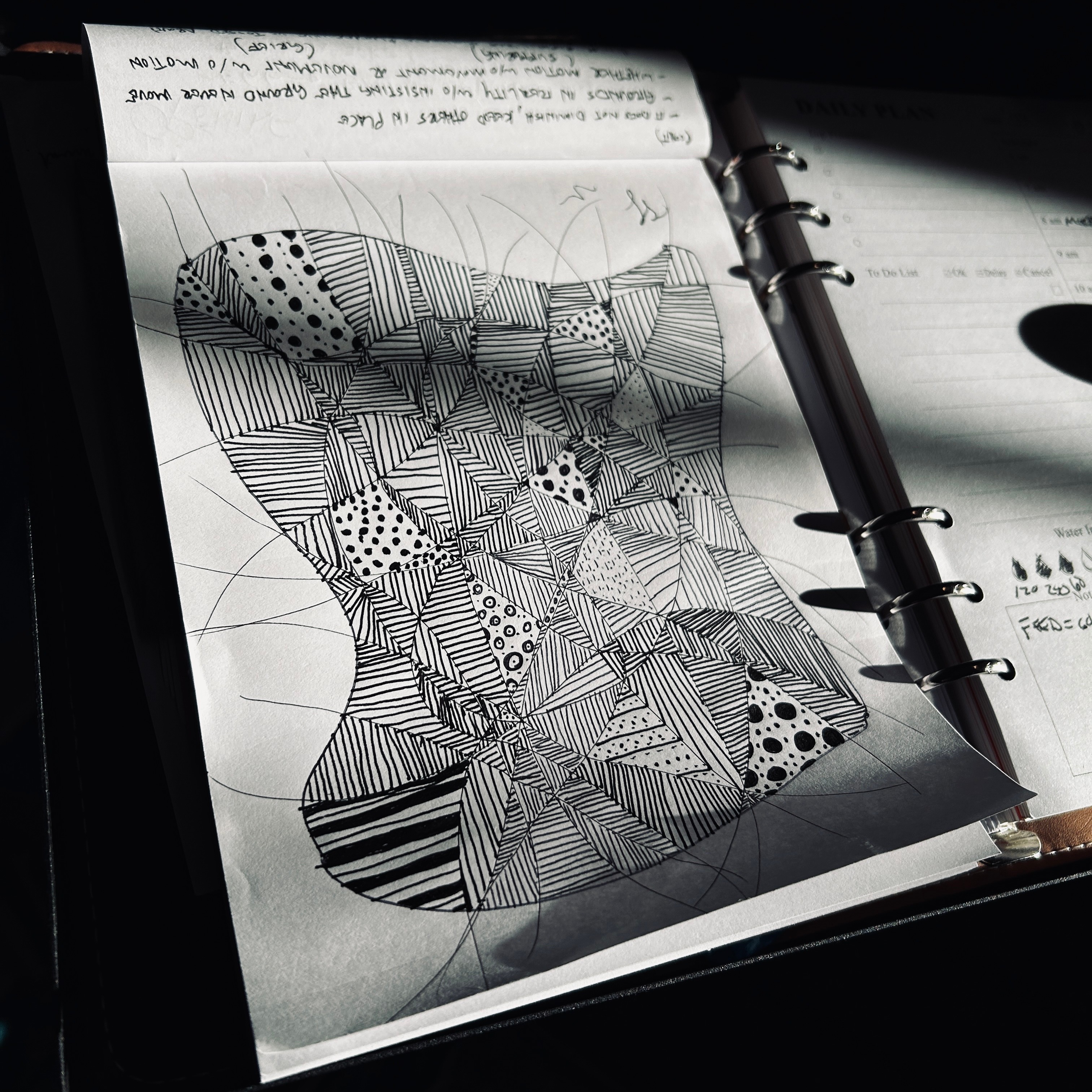
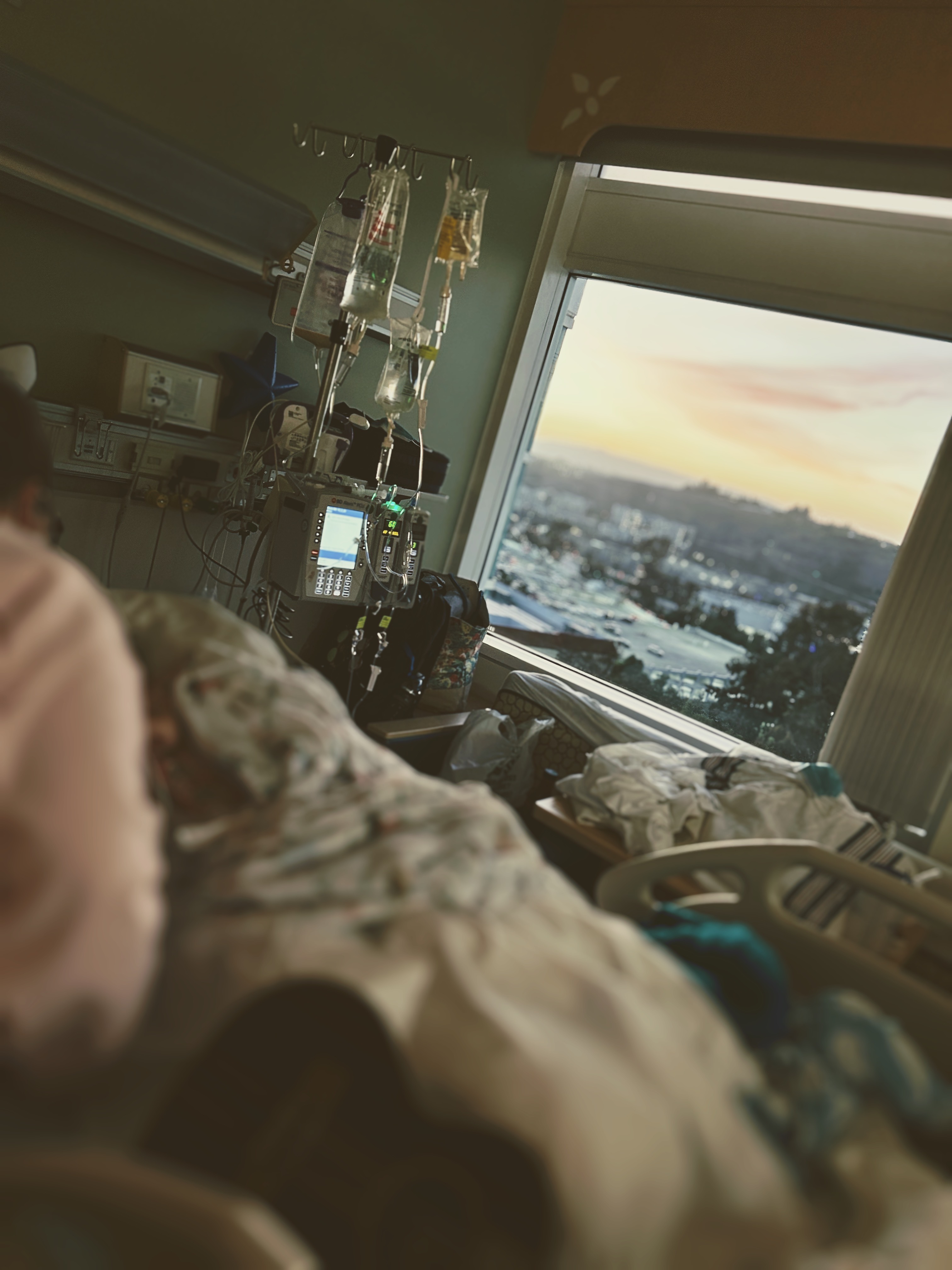
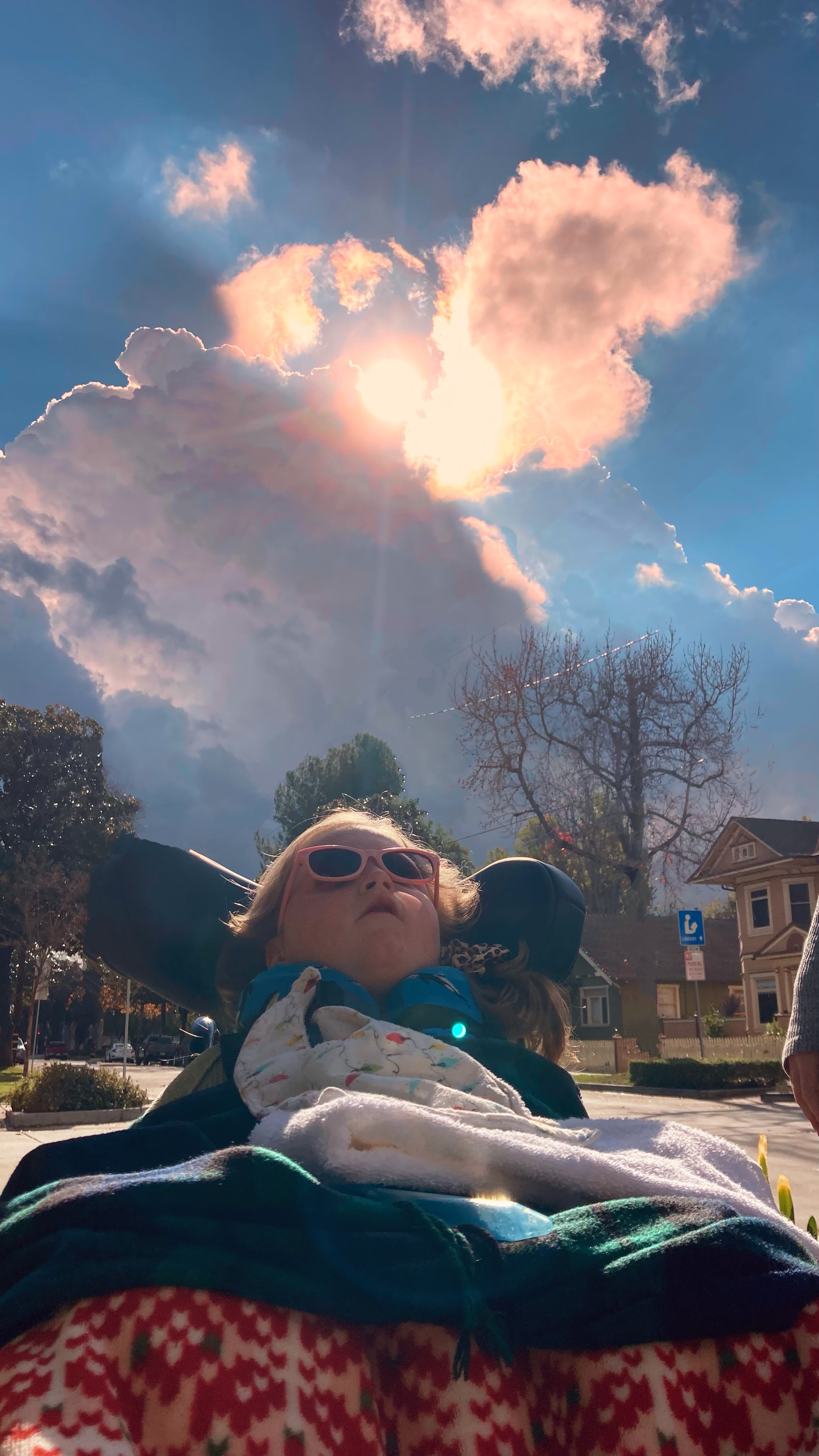

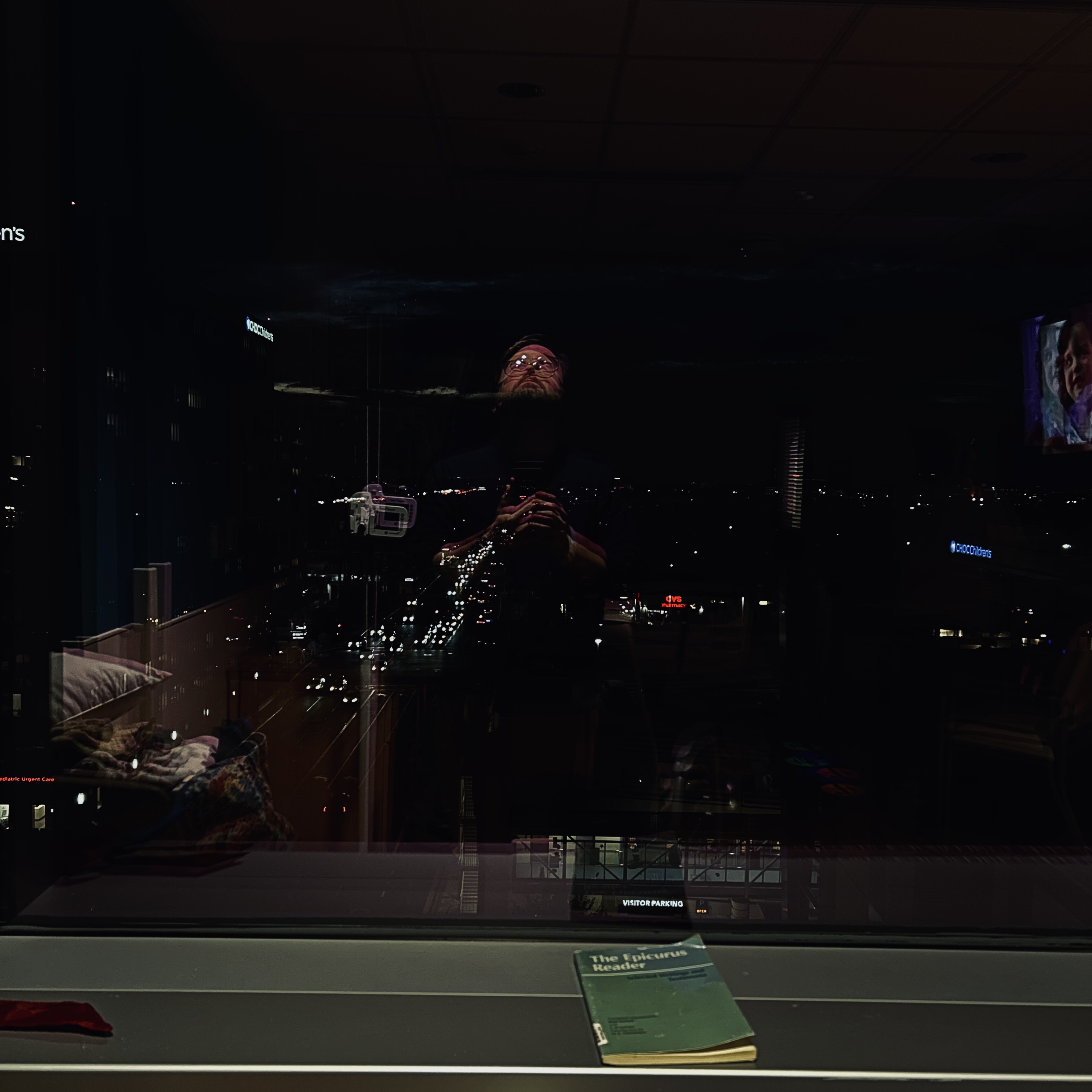
 Our Little Kartoffel